
Sympathy card design approach: simple printable guide
TL;DR:
- A sympathy card design should prioritize restraint, using muted palettes, simple imagery, and sincere messages. Such a calming approach emphasizes white space and minimal embellishments to evoke emotional sensitivity. Handmade cards serve as meaningful acts of witness, focusing on time and intention rather than technical perfection.
A sympathy card design approach is a comfort-first method of composing colour, imagery and wording so the finished card feels calm and sincere rather than decorative. The core idea is restraint: a muted palette, one nature-inspired focal image, minimal embellishment and a short, honest message. Get those four elements right and the card does its job, regardless of your skill level or the tools you use.
Table of Contents
- What does a good sympathy card design approach look like?
- What should you write inside a sympathy card?
- How do you design a printable sympathy card step by step?
- What print specs do UK crafters need for sympathy cards?
- Where can you find printable sympathy card templates?
- Three fast mini blueprints you can make in 15–30 minutes
- Key takeaways
- Why handmade sympathy cards still matter
- Craftsuprint printable sympathy card resources
- Useful sources
- FAQ
What does a good sympathy card design approach look like?
Three principles underpin every successful sympathy card: restraint, clarity and emotional sensitivity. Restraint means one focal point, generous white space and no competing embellishments. Clarity means the recipient reads the sentiment immediately, without hunting through a busy layout. Emotional sensitivity means every choice — colour, symbol, texture — signals calm rather than celebration.
Colour palettes that work
Soft, muted tones are the safe and effective choice. Three palettes that consistently work:
- Neutral warmth: warm white, soft taupe and pale sage. Quiet and universally appropriate.
- Muted blue and grey: pale slate, dove grey and dusty blue. Conveys peace without coldness.
- Soft blush and mauve: pale pink, muted mauve and cream. Gentle and feminine without being festive.
Light blues, greens, soft pinks and mauves all read as comforting. Avoid bright, bold colours unless they carry specific personal meaning for the recipient.
Imagery and symbols
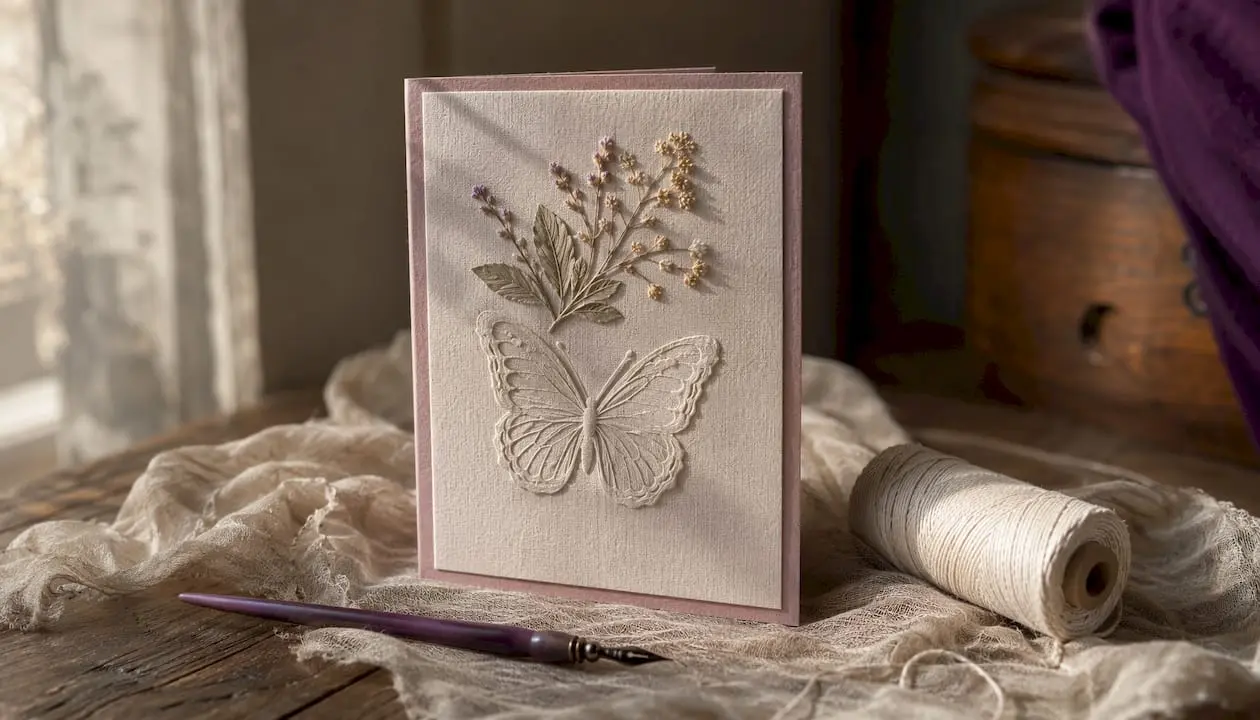
Butterflies, doves, trees and simple florals are the most recognised symbols of peace and continuity. A single butterfly or a bare winter tree communicates more than a cluster of mixed motifs. Craftsuprint’s sympathy cutting files include ready-to-use versions of all these motifs, which saves considerable time when you are working from a printable file.
Layout and embellishment
One visual focal area is enough. Place your chosen image in the upper or centre portion of the front panel, then let white space carry the rest. Avoid glitter, noisy textures or layered die-cuts that draw the eye away from the sentiment. Where texture genuinely adds warmth, embossing and watercolour washes used sparingly are the most appropriate choices.
Pro Tip: Apply anti-static powder before heat embossing to prevent stray powder sticking to the card surface, and always pre-heat your heat tool for a clean, even melt.
What should you write inside a sympathy card?
Short and sincere beats long and elaborate every time. Carissa Wiley frames the goal plainly: the card should let the recipient feel seen and remembered, not showcase the maker’s technical skill. Lindsey Bugbee adds that recipients value the time and intention behind a handmade card far more than its technical polish.
Four categories cover most situations:
- Direct sympathy: “With heartfelt sympathy.” / “Words cannot express how sorry I am for your loss.”
- Support and presence: “Thinking of you during this difficult time.” / “We are here whenever you need us.”
- Remembering: “May your memories bring you comfort.” / “They will always be remembered.”
- Faith-based (when appropriate): “Praying for peace and comfort for you and your family.”
Keep the inside message to two or three lines. Avoid platitudes (“Everything happens for a reason”), humour unless you know the recipient very well, and overly formal phrasing that feels distant. A single personalised memory line — “I will always remember her laugh” — adds more warmth than a paragraph of general condolence. The role of sentiments in greeting cards matters more than most crafters realise; placement and brevity are as important as the words themselves.
How do you design a printable sympathy card step by step?
A repeatable workflow keeps the process calm and the result consistent.
- Define the brief. Choose your tone: formal, informal or faith-based. Consider the recipient’s beliefs and how well you know them.
- Select palette and motif. Pick one colour family from the palettes above and one focal image. Resist adding a second motif.
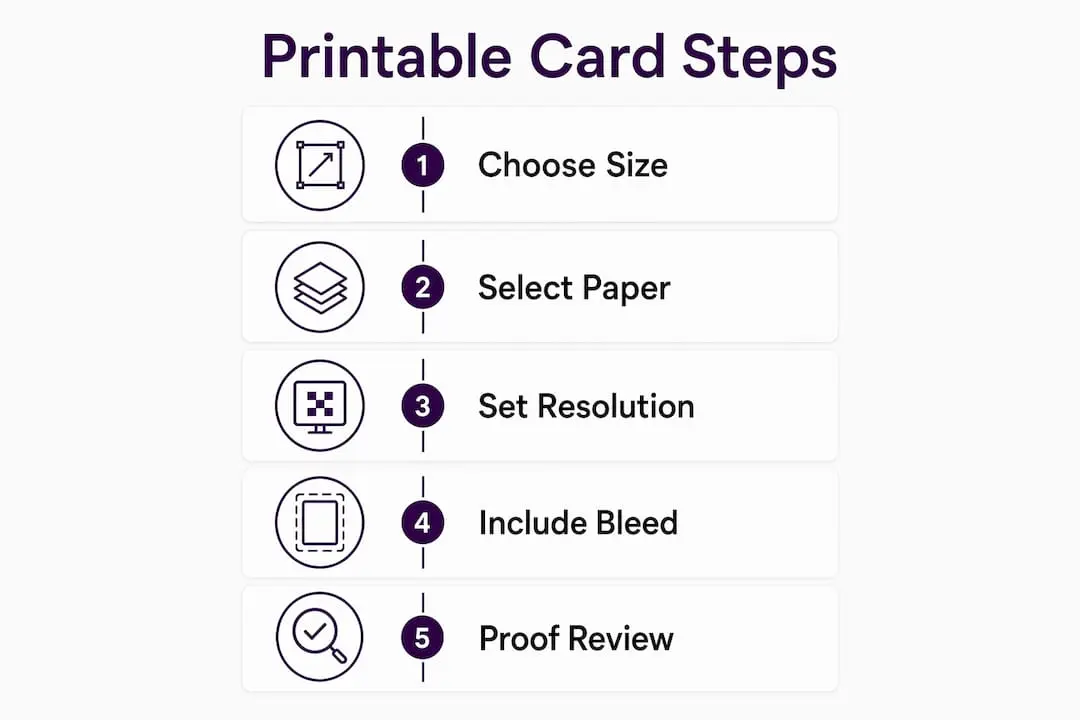
- Set up your template. Work at A5 (148 × 210 mm) or DL (99 × 210 mm) for standard UK envelopes. Add 3 mm bleed on all sides and keep text at least 5 mm inside the trim edge.
- Place elements in hierarchy. Focal image first, sentiment second, white space third. Nothing else.
- Add texture sparingly. A watercolour wash background or a single embossed panel is sufficient.
- Hand-letter or type the sentiment. If hand-lettering, draft in pencil first to check spacing before committing with ink.
- Export and proof. Save as PDF (print) or PNG at 300 DPI minimum. Print a test copy on plain paper before cutting cardstock.
- Final check. Spelling, margin clearance, colour accuracy on screen versus print.
Pro Tip: Batch-make three or four cards with neutral sentiments such as “Thinking of You” so you have versatile designs ready to personalise quickly when the need arises.
Time and cost for a single printable sympathy card vary. A digital-only card using a downloaded template takes roughly 20–40 minutes. A handmade version with embossing or watercolour work runs 45–90 minutes. Material costs for a home-printed card on quality cardstock typically fall between £0.50 and £2.00 per card, depending on ink coverage and paper weight.
What print specs do UK crafters need for sympathy cards?
Getting the file right before you print avoids wasted cardstock and disappointing results.
| Specification | Recommended value |
|---|---|
| Standard card size (UK) | A5 folded (148 × 210 mm) or DL (99 × 210 mm) |
| Bleed | 3 mm on all sides |
| Safe area (text/images) | 5 mm inside trim edge |
| Resolution | 300 DPI minimum; 350 DPI for commercial print |
| File format | PDF/X-1a for print services; PNG for home printing |
| Cardstock weight | 250–350 gsm |
| Finish | Matte preferred; gloss is inappropriate for sympathy cards |
Matte cardstock absorbs ink evenly and feels considered rather than showy. For home printing, 250 gsm is the practical upper limit for most inkjet printers; professional print services handle 300–350 gsm without issue. Always embed fonts in your PDF and convert spot colours to CMYK before sending to a print bureau.
Where can you find printable sympathy card templates?
The types of resource most useful for this project:
- Editable templates in PDF, SVG or layered formats for quick personalisation
- Clip art and motif packs featuring butterflies, doves, florals and trees
- Sentiment packs with pre-written copy-ready phrases
- Digital paper for patterned backgrounds that do the visual heavy lifting
Barb Brimhall’s advice is worth repeating here: let patterned paper carry the design so the card stays elegant without complicated layering. Craftsuprint is built around exactly this philosophy. Its download library includes sympathy-themed template packs, digital paper collections and sentiment sets, all formatted as print-ready files with clear licence terms. Understanding why digital paper patterns work so well for sympathy cards comes down to one thing: a single sheet of well-chosen patterned paper removes the need for multiple embellishments.
For editing and proofing, free tools such as Canva, Inkscape (SVG files) and Adobe Acrobat Reader (PDF proofing) cover most needs without cost.
Pro Tip: Always check the licence flag on any downloaded file before selling finished cards. Most personal-use licences do not cover commercial sale; look for an explicit commercial-use permission or a separate commercial licence tier.
Three fast mini blueprints you can make in 15–30 minutes
Blueprint 1: Soft watercolour centre
- Materials: A5 white cardstock, watercolour wash background (printed or painted), single butterfly or dove motif, black fine-liner for sentiment
- Layout: Watercolour wash fills the front panel; motif centred in the upper third; sentiment in a thin-bordered box in the lower third
- Inside message: “Thinking of you with love and sympathy.”
Blueprint 2: Patterned paper badge
- Materials: A5 card base, one sheet of muted floral digital paper (printed), circular die-cut or hand-cut sentiment badge in cream card
- Layout: Patterned paper covers the full front; cream badge adhered slightly off-centre for visual interest; sentiment printed or hand-written on the badge
- Inside message: “With heartfelt sympathy and love.”
Blueprint 3: Embossed panel with floral accent
- Materials: A5 grey or sage card base, embossing folder (subtle linen or dot texture), small printed floral accent, white gel pen for sentiment
- Layout: Embossed panel covers two-thirds of the front; floral accent in the lower-left corner; sentiment in white gel pen across the panel
- Inside message: “May your memories bring you comfort.”
To share or send to a print service, photograph the finished card on a plain white or linen background in natural light, or export your digital file as a PDF/X-1a at 300 DPI.
Pro Tip: For Blueprint 2, choosing the right card pattern makes the difference between a card that looks considered and one that looks busy. Stick to patterns with a repeat scale smaller than 30 mm for A5 cards.
Key takeaways
A sympathy card design approach works because restraint, a muted palette and a short sincere message do more emotional work than any amount of embellishment.
| Point | Details |
|---|---|
| Restraint is the core principle | One focal image, generous white space and no competing embellishments keep the card comforting. |
| Palette and imagery matter | Muted blues, greens, taupes and soft pinks; use butterflies, doves or simple florals as symbols. |
| Keep messages brief | Two to three lines maximum; a single personalised memory line adds more warmth than a long paragraph. |
| UK print specs | A5 or DL size, 3 mm bleed, 300 DPI minimum, 250–350 gsm matte cardstock, PDF/X-1a for print services. |
| Craftsuprint for templates | Craftsuprint’s download library offers print-ready sympathy templates, digital paper and sentiment packs with clear licence terms. |
Pro Tip: Make a small stash of three or four neutral sympathy cards in advance. Draft sentiments in pencil, choose matte cardstock, and store finished cards in a flat box so they are ready to personalise at short notice.
Why handmade sympathy cards still matter
There is a tendency in craft circles to treat sympathy cards as a technical challenge: the right embossing technique, the perfect colour match, the cleanest die-cut edge. That framing misses the point entirely. A sympathy card is not a portfolio piece. It is a quiet act of witness, and the recipient almost never notices whether the embossing is perfectly centred.
What they do notice is that someone took time. That is the argument for handmade cards that no printed alternative can fully replicate, and it is why the Craftsuprint community continues to produce them in volume. The platform’s template library and designer community exist precisely to lower the technical barrier so crafters can focus on the intention rather than the production problem.
Craftsuprint printable sympathy card resources
Printable sympathy cards are one area where having the right starting file genuinely shortens the process. Craftsuprint’s Create & Craft downloads include sympathy-themed template packs formatted to UK print standards, digital paper collections in muted palettes, and sentiment sets you can drop straight into a layout. Files come with clear licence information, layered formats for easy editing, and community support if you get stuck.
If you are new to the platform, the free Create & Craft members gift is a practical starting point: download it, open the files, and you will have a working sympathy card template within the hour. Browse the full download library to find the pack that fits your style, then print, personalise and post.
Useful sources
- Card making tips for sympathy cards — StampinSavvy: design principles, palette guidance, batching advice and wording examples
- 5 tips for creating a handmade sympathy card — Ellen Hutson (Carissa Wiley): the “act of witness” framing and sentiment focus
- How to create an elegant sympathy card — Barb Brimhall: patterned paper as the primary design tool for beginners
- Serene DIY sympathy card tutorial — The Postman’s Knock (Lindsey Bugbee): therapeutic value and the importance of time and intention
- Elegant sympathy card tutorial — The Postman’s Knock: pencil-draft hand-lettering workflow
- Easy techniques for a stunning sympathy card — Dahlhouse Designs: embossing tips and anti-static powder technique
- 3 meaningful sympathy card tips — Altenew: colour palette selection and calming symbol guidance
FAQ
What is the best colour palette for a sympathy card?
Muted, soft tones work best: pale blues, greens, greys, taupes and soft pinks. Avoid bright or bold colours, which read as celebratory rather than comforting.
How long should a sympathy card message be?
Two to three lines is the ideal length. Short, sincere lines such as “Thinking of you” or “With heartfelt sympathy” carry more weight than a lengthy paragraph.
What file format should I use for a printable sympathy card?
Use PDF/X-1a for professional print services and PNG at 300 DPI minimum for home printing. Always add 3 mm bleed and keep text 5 mm inside the trim edge.
Where can I download ready-made sympathy card templates?
Craftsuprint’s download library offers print-ready sympathy card templates, digital paper and sentiment packs formatted to UK print standards, with clear licence terms for personal and commercial use.
Can I sell sympathy cards I make from downloaded templates?
Only if the template licence explicitly permits commercial use. Check the licence flag on every downloaded file before selling finished cards; personal-use licences do not cover commercial sale.