
What is a crafting explainer article?

TL;DR:
- A crafting explainer article teaches a concept by providing a clear definition and practical context. It helps readers understand why a technique matters and how it works before starting a project. These articles are essential for learning new techniques, making informed supply decisions, and building confidence in crafting skills.
A crafting explainer article is an educational piece that defines and breaks down a crafting concept or process in clear, logical sections so readers move from confusion to understanding. In content writing, the standard industry term for this format is simply an “explainer article.” Within the crafting niche, it answers questions like “What is decoupage?” or “How does heat embossing work?” rather than selling a product or sharing a personal story. You will find this format across Craftsuprint’s blog, specialist crafting sites, and educational resource pages. Understanding what a crafting explainer article is helps you find better learning material and get more from every guide you read.
What is a crafting explainer article and how does it differ from other content?
A crafting explainer article is defined by its intent: to educate rather than promote, narrate, or entertain. Shopify describes content writing as creating assets that build trust by providing information rather than direct advertising. Explainer articles sit firmly in that educational category. They are not product reviews, personal project diaries, or step-by-step tutorials, though they may share surface similarities with all three.

The clearest distinction is purpose. A personal crafting blog post tells you what the writer made last weekend. A crafting tutorial article shows you exactly how to replicate a specific project. A crafting explainer article tells you what a concept is, why it matters, and how it works at a conceptual level. Merriam-Webster defines craft as skill in planning, making, or executing with dexterity. A good explainer unpacks that definition within a specific context, such as paper crafting, card making, or mixed media.
Three characteristics separate crafting explainers from other crafting content:
- Educational intent. The article exists to close a knowledge gap, not to drive a purchase or showcase a finished project.
- Structural clarity. Sections follow a logical order: definition first, context second, process or examples third, summary last.
- Plain language. Technical crafting terms such as “scoring,” “die cutting,” or “heat tool” are defined the first time they appear, not assumed.
Pro Tip: When you pick up a crafting article, check the opening sentence. If it starts with a direct definition or a “what is” statement, you are reading an explainer. If it opens with “I made this gorgeous card last Tuesday,” you are reading a personal blog post.
The distinction matters because you read these formats differently. You skim a tutorial for steps. You read an explainer to build understanding you can carry into multiple projects.
How does a crafting explainer article structure information?
Top-performing explainers use a definition-first approach positioned at the very top, followed by just enough detail to prevent confusion. This structure is not arbitrary. It mirrors the way readers search for information: they want the answer first, then the context.
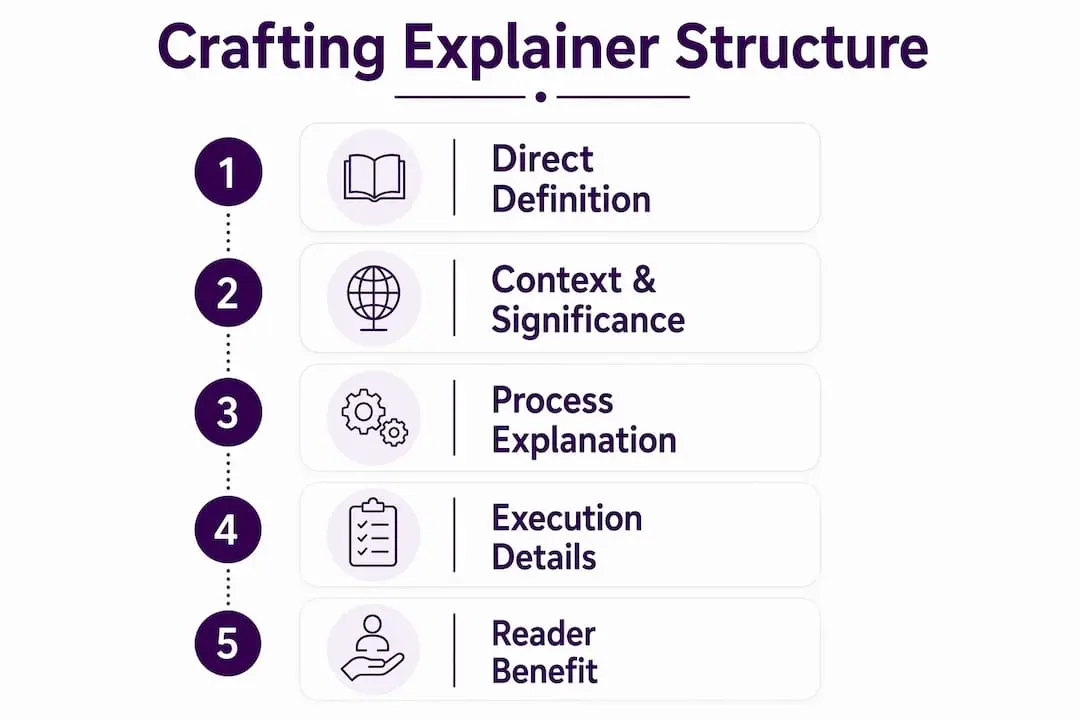
A well-built crafting explainer follows five clear stages:
- Direct definition. One or two sentences that answer “What is X?” without preamble. For example: “Quilling is the art of rolling narrow strips of paper into coils and arranging them to form decorative designs.”
- Context and significance. Why does this concept matter to crafters? Quilling, for instance, requires no specialist machinery, making it accessible to beginners with minimal supplies.
- Process or cause-and-effect explanation. How does it work? This section explains the mechanics: the paper strips, the quilling tool, the glue, and the drying time.
- Real-world crafting examples. Concrete illustrations anchor the theory. A quilling explainer might reference greeting card borders, framed wall art, or jewellery components.
- Summary or reinforcing insight. A closing sentence or short paragraph that restates the core idea and connects it to the reader’s practice.
The table below shows how each stage functions within the article and what it delivers to the reader.
| Stage | Function | Reader benefit |
|---|---|---|
| Direct definition | Answers “What is X?” immediately | Removes initial confusion |
| Context and significance | Explains why the concept matters | Motivates further reading |
| Process explanation | Details how it works | Builds conceptual understanding |
| Real-world examples | Illustrates abstract ideas | Makes knowledge usable |
| Summary | Reinforces the core idea | Aids retention and recall |
W3C’s guidance on writing explainers highlights brevity, readability, and regular updates as the three pillars of an effective explainer. For crafting content, that means revisiting articles when new tools or materials enter the market. A quilling explainer written before electric quilling tools became widely available would now be incomplete.
The five-stage structure also separates concept clarification from execution details. This separation is deliberate. Many beginner guides blur these two layers, leaving readers who understand the theory unable to perform the task. A strong crafting explainer keeps “what it is” and “how to do it” in distinct sections.
Crafting explainer vs tutorial vs general crafting content
Understanding the differences between these three content types helps you choose the right resource for your needs. Each serves a different purpose, and confusing them wastes time.
| Content type | Primary purpose | Typical structure | Best used when |
|---|---|---|---|
| Crafting explainer article | Define and clarify a concept or process | Definition, context, explanation, examples, summary | You need to understand what something is before attempting it |
| Crafting tutorial article | Guide a reader through a specific project | Materials list, numbered steps, images, tips | You already understand the concept and want to make something |
| General crafting content | Inform, inspire, or entertain | Flexible: lists, stories, round-ups, reviews | You want ideas, product recommendations, or community connection |
A crafting tutorial article assumes you already know what the technique is. It skips the definition and moves straight to the materials list and numbered steps. A crafting explainer article assumes you do not yet know what the technique is. It starts from scratch and builds your understanding before any practical instruction begins.
General crafting content is the broadest category. A “10 best card-making kits for beginners” article is general crafting content. It informs and inspires but does not define or teach. Platforms like Craftsuprint publish all three types, and knowing which you are reading helps you extract the right value from each.
The appropriate use of a crafting explainer is specific. Reach for one when you encounter an unfamiliar term in a tutorial, when you want to understand a technique before investing in supplies, or when you are helping a newer crafter grasp the foundations. Explainer articles align closely with search queries such as “what is X” and “how does X work,” which is why they surface reliably in search results and AI assistant responses.
How can crafters benefit from and use explainer articles?
Crafting explainer articles deliver the most value when you use them at the right moment in your learning process. The clearest benefit is terminology. Crafting has a dense vocabulary: “bone folder,” “brayer,” “Copics,” “Nuvo drops,” “distress ink.” Encountering these terms mid-tutorial without context breaks your flow and erodes confidence. A good explainer article resolves that in under five minutes.
The benefits extend well beyond vocabulary:
- Technique selection. Before buying a Cricut or a Silhouette cutting machine, an explainer article on electronic cutting helps you understand what each machine does and whether it suits your projects.
- Supply decisions. Understanding the difference between cardstock weights, for example, prevents costly mistakes when ordering materials from resources like craft supply listings.
- Skill progression. Explainers give you the conceptual framework to move from one skill level to the next. Once you understand what “dry embossing” is, you can follow a tutorial with confidence rather than guessing at each step.
- Troubleshooting. When a project goes wrong, an explainer that covers the underlying process helps you identify where the error occurred.
Pro Tip: Keep a short personal glossary as you read crafting explainers. Note the term, its definition, and one example of where it applies. After a few weeks, you will have a reference document tailored to your specific crafting interests.
Effective crafting explainers reduce a common beginner failure: grasping concepts without building a usable internal framework. The “mental-label plus model plus examples” approach, where an article first labels the concept, then explains why it matters, then shows it in action, gives you something to hold onto when you sit down to craft. Reading an explainer on watercolour resist techniques, for instance, means you understand why the wax repels the paint before you pick up a candle stub and a brush.
Trusted resources matter here. Craftsuprint’s educational craft guides demonstrate how well-structured explainer content translates directly into improved practical skills. Pairing an explainer with hands-on practice is the most reliable route to retaining what you have read. Read the concept, then make something with it the same day.
Key takeaways
A crafting explainer article is the most direct route from not knowing what a crafting concept is to understanding it well enough to apply it.
| Point | Details |
|---|---|
| Definition-first structure | Start with a direct one or two sentence definition to anchor the reader immediately. |
| Distinct from tutorials | Explainers clarify concepts; tutorial articles guide you through specific project steps. |
| Five-stage format | Definition, context, process, examples, and summary form the backbone of every strong explainer. |
| Terminology clarity | Use explainers to decode unfamiliar crafting terms before starting a new technique or project. |
| Pair with practice | Reading an explainer delivers the most value when followed by hands-on application the same day. |
Why crafting explainers changed how I learn new techniques
The first time I realised I had been reading crafting content wrong was when I tried to follow a tutorial on alcohol ink techniques without understanding what alcohol ink actually does to a surface. I had the inks, the Yupo paper, and the isopropyl alcohol. What I lacked was any conceptual model of how the ink moves, why it reacts to alcohol, and what “pushing” the ink means in practice. The tutorial assumed I knew. I did not.
That experience taught me something I now consider non-negotiable: always read the explainer before the tutorial. The two formats are not interchangeable. A tutorial gives you steps. An explainer gives you understanding. Without understanding, steps become a recipe you follow blindly, and the moment something goes wrong, you have no framework to diagnose it.
What I find most undervalued about crafting explainers is their role in supply decisions. Crafters, especially beginners, spend money on tools and materials they do not yet understand. A five-minute explainer on the difference between a scoring board and a scoring tool would have saved me one unnecessary purchase in my first year. The explainer is not glamorous content. It does not photograph well. But it is the content that actually builds competence.
My advice is to treat crafting explainers as your pre-flight checklist. Before any new technique, find a well-structured explainer, read it fully, and only then move to the tutorial or the project. The starter guide for hobbyists on Craftsuprint is a good example of content that bridges conceptual grounding with practical direction. Seek out that combination deliberately.
— Rob
Craftsuprint’s resources for crafters who want to learn
Craftsuprint brings together downloadable craft projects, tutorials, and educational guides in one place for hobby crafters at every level.
Whether you are building your first paper craft or expanding into new techniques, Craftsuprint’s craft supplies catalogue gives you the materials to put your new knowledge into practice immediately. Members also gain access to the free Create and Craft gift, a practical starting point for anyone ready to move from reading about crafting to actually doing it. The platform’s community features, weekly freebies, and categorised downloads mean your next explainer and your next project are always within reach.
FAQ
What is the main purpose of a crafting explainer article?
A crafting explainer article exists to move a reader from confusion to understanding by defining a crafting concept clearly and logically. It answers “what is X” and “how does X work” rather than guiding a specific project.
How is a crafting explainer different from a crafting tutorial article?
A crafting tutorial article assumes you already understand the technique and walks you through project steps. A crafting explainer article defines the concept first, making it the right starting point before you attempt any tutorial.
What structure does a good crafting explainer follow?
A strong crafting explainer opens with a direct definition, adds context and significance, explains the process, provides real-world examples, and closes with a summary that reinforces the core idea.
When should I use a crafting explainer article?
Reach for a crafting explainer when you encounter an unfamiliar term, before investing in new supplies or tools, or when you want to understand a technique at a conceptual level before following a tutorial.
Are crafting explainer articles useful for experienced crafters?
Yes. Experienced crafters use explainers to understand new tools, materials, or techniques outside their existing specialism, and to build the conceptual grounding needed before attempting an unfamiliar process.