
Types of craft tutorials: a guide for hobbyists
TL;DR:
- Craft tutorials are essential guides for learning specific techniques and completing projects. They include video, written, live workshops, and community advice, each suited to different learning styles. Combining multiple formats yields the best results for skill development and troubleshooting.
Craft tutorials are instructional guides that teach specific techniques or help you complete a project from start to finish. They are the primary way hobbyists acquire new skills, whether you are picking up a crochet hook for the first time or tackling an intricate paper craft design. The types of craft tutorials available today span video walkthroughs, live virtual workshops, written patterns, and community forums, each suited to different learning styles and project goals. Knowing which format works best for you saves time, reduces frustration, and gets you to a finished piece faster.
Types of craft tutorials popular among hobbyists
Craft tutorials fall into several distinct categories, and each one serves a different purpose. Understanding the differences helps you pick the right format before you start a project, not halfway through it.

Video tutorials are the most widely used format. Platforms such as YouTube offer free, on-demand access to thousands of technique demonstrations. Paid membership platforms like Skillshare and Creativebug provide structured, skill-specific classes that filter content by difficulty and craft type. The trade-off is that you watch at your own pace but receive no feedback on your work.
Virtual live workshops operate differently. An instructor leads a session in real time, answers questions, and corrects mistakes as they happen. This format pulls learners forward beyond what solitary practice achieves, because the feedback loop is immediate.
Written and photo-based tutorials remain the backbone of precision crafts. Knitting patterns, sewing instructions, and paper craft guides rely on numbered steps, diagrams, and close-up photographs. Downloadable PDFs are particularly useful because you can print them, annotate them, and return to a specific step without scrubbing through a video.
Interactive and app-based tutorials are a growing category. Some platforms combine short video clips with quizzes, progress tracking, and community comment sections. These work well for crafters who like a structured curriculum but prefer to learn on a mobile device.
Community-driven tutorials sit in a category of their own. Forums, maker groups, and social platforms generate peer-to-peer guidance that no single instructor can replicate. You get real-world fixes, pattern adjustments, and honest opinions about which materials actually hold up.
| Format | Best for | Cost range | Feedback available |
|---|---|---|---|
| Free video tutorials | Self-paced beginners | Free | None |
| Paid membership platforms | Structured skill building | Low monthly fee | Limited |
| Live virtual workshops | Intermediate to advanced | Moderate per session | Real-time |
| Written patterns and PDFs | Precision crafts | Free to low | None direct |
| Community forums | Troubleshooting and adapting | Free | Peer feedback |
Pro Tip: Before starting any new craft, search for a written pattern or PDF alongside a video tutorial. The written version gives you a reference point when the video moves too fast.
How do video tutorials differ from virtual workshops?
Video tutorials and virtual workshops are both digital formats, but they deliver very different learning experiences. Choosing the wrong one for your skill level or project type is one of the most common reasons hobbyists stall mid-project.
Video tutorials offer flexibility above all else. You pause, rewind, and revisit a technique as many times as you need. They work particularly well for visual learners who need to see a hand movement or colour-mixing process repeated slowly. The limitation is significant, though. Process videos lack sensory feedback such as the tension in a thread or the resistance of card stock, which are things you can only learn by doing. A video can show you how to hold a crochet hook, but it cannot tell you whether your tension is too tight.
Virtual workshops close that gap. A live instructor watches your work, identifies errors in real time, and adjusts their teaching to suit your specific project. Improvisational teaching that adapts to the learner’s actual needs, rather than following a rigid script, is the most effective approach in craft education. That is exactly what a good virtual workshop delivers.
The practical differences come down to three factors.
- Flexibility: Video tutorials win. You choose when and how long you practise.
- Feedback: Virtual workshops win. Real-time correction prevents bad habits from forming.
- Cost: Video tutorials are often free. Virtual workshops carry a per-session fee, though the skill gain per hour is higher.
For beginners, a free video tutorial is the right starting point for most crafts. Many starter projects cost under £1 in materials and require minimal setup, so the barrier to entry is low. Once you have the basics, a virtual workshop accelerates your progress in ways that self-directed video watching rarely does.
Pro Tip: If you are attending a virtual workshop, prepare your materials the night before and test your camera angle. Instructors give better feedback when they can clearly see your hands and your work.
Exploring text-based tutorials and downloadable patterns
Written tutorials are the oldest format in craft education, and they remain indispensable for precision work. A knitting pattern, a sewing template, or a paper craft schematic gives you a permanent reference that does not disappear when a video is taken down or a platform changes its algorithm.
The strength of a written tutorial lies in its specificity. A well-written pattern states exact measurements, material weights, stitch counts, and assembly sequences. You can work through it at any pace, mark your progress, and return to a specific row or step without searching through footage. For paper crafts and card making, downloadable PDF templates are particularly effective because they include cut lines, fold guides, and colour references all in one document.
Written tutorials also capture something that video often misses. Effective craft tutorials include troubleshooting sections and behind-the-scenes content that document the improvisational adaptations experienced crafters make. A pattern that explains why a seam allowance changes at a curved edge teaches you more than one that simply tells you to cut along a line.
The best approach combines formats. Use a written pattern as your primary guide and a video as a visual supplement for any step that is difficult to picture from text alone. Craftsuprint hosts a range of downloadable craft tutorials and printable project guides that pair well with this method, particularly for card making and paper craft projects.
- Written patterns suit precision crafts: knitting, sewing, paper crafts, and card making.
- Downloadable PDFs are permanent, annotatable, and platform-independent.
- Tutorials that include troubleshooting sections teach adaptive skills, not just rote steps.
- Combining written and video formats covers both the “what” and the “how it looks.”
Community-driven tutorials and social learning
Online craft communities generate a type of tutorial that no single instructor or platform can produce. They are living documents, updated constantly by hundreds of crafters who have worked through the same pattern, hit the same problem, and found a fix.
During the pandemic, community forums like Ravelry and Reddit became primary learning environments for beginners who could not access in-person classes. Shared tips, project notes, and modification threads filled the gaps that video tutorials left open. That dynamic did not disappear when studios reopened. Community-driven learning is now a permanent and valued part of how hobbyists develop skills.
The specific value of community tutorials is tacit knowledge. Craft documentation often misses nuanced adaptations that experienced makers apply instinctively. A forum thread where ten crafters discuss why a particular glue fails on glossy card stock teaches you something no official tutorial bothers to mention. That kind of knowledge only surfaces through shared experience.
Peer feedback also builds confidence in a way that passive video watching does not. When another crafter comments on your finished project, points out a technique improvement, or shares a material substitution, you receive the kind of mentorship and feedback that accelerates skill development beyond what formal tutorials alone provide.
- Join a forum or maker group specific to your craft before you start a complex project.
- Search existing threads before posting a question. Most problems have already been solved.
- Share your finished work, even when it is imperfect. Feedback from peers is more specific than generic tutorial advice.
- Use community threads alongside videos for real-world pattern fixes that original tutorials omit.
Pro Tip: When you find a forum thread that solves a problem you had, save it. Build a personal reference library of community fixes alongside your official patterns and tutorials.
1. Free video tutorials
Free video tutorials are the entry point for most hobbyists. YouTube hosts millions of craft demonstrations across every skill level and technique. The format works best for visual learners who need to see a process in motion before attempting it themselves.
The main limitation is the absence of feedback. Process videos demonstrate technique sequences effectively, but they cannot replicate the sensory feedback of handling materials. You will not know if your paper fold is too sharp or your stitch tension is off until you practise with the actual materials in hand. Use free video tutorials as a starting point, then supplement with hands-on practice and community feedback.
2. Paid membership platform courses
Paid platforms offer structured curricula that free video libraries cannot match. Courses are organised by skill level, technique, and craft type, which removes the guesswork of deciding what to learn next.
The cost is modest relative to the value. A monthly subscription gives you access to dozens of courses, often with downloadable resources and community comment sections. This format suits crafters who want a clear progression path rather than a collection of unrelated tutorials.
3. Live virtual workshops
Live virtual workshops deliver the closest digital equivalent to an in-person class. An instructor guides you through a project in real time, answers questions, and adjusts their approach based on what they see from participants.
Teaching through demonstration and mentorship creates feedback loops that pre-recorded content cannot replicate. If you are working on a technique that requires precise hand positioning or material handling, a live workshop is worth the higher cost per session.
4. Downloadable PDF patterns and written guides
PDF patterns are permanent, portable, and precise. They suit crafts where measurements, stitch counts, and assembly sequences must be exact. Card making, paper crafts, knitting, and sewing all rely heavily on written patterns.
Craftsuprint’s range of paper craft kits includes printable templates that function as self-contained tutorials. Each kit provides cut lines, fold guides, and assembly instructions in a single document, which removes the need to cross-reference multiple sources.
5. Photo-based step-by-step guides
Photo tutorials break a process into discrete visual stages. Each photograph shows the exact state of the project at a specific point, which makes it easy to check your progress against a reference image.
This format works particularly well for crafts with clear visual milestones, such as card assembly, decoupage, or paper folding. The limitation is that photos cannot convey movement or timing, so they are best used alongside a short video for any dynamic technique.
6. App-based interactive tutorials
App-based tutorials combine short video clips, written instructions, and progress tracking in a single interface. Some include quizzes or community features that encourage consistent practice.
This format suits crafters who prefer learning on a mobile device and want a structured programme rather than a loose collection of videos. The interactivity also helps with retention, since you engage with the material rather than passively watching it.
7. Community forum threads and maker groups
Forum threads on platforms such as Ravelry and Reddit function as crowd-sourced tutorials. A single thread can contain pattern corrections, material substitutions, technique variations, and troubleshooting advice contributed by dozens of experienced crafters.
The value is in the specificity. A forum thread about a particular paper craft kit will contain observations that no official tutorial includes, because the contributors have actually completed the project and encountered its real-world challenges. Consulting community threads alongside videos provides dynamic support that original tutorials often omit.
8. Social media short-form tutorials
Short-form tutorials on platforms such as Instagram and TikTok condense a technique into 30–90 seconds. They are excellent for discovering new ideas and getting a quick overview of a process.
The risk is that visual-only craft content optimised for social media often prioritises aesthetics over material integrity. A technique that looks clean on screen may skip steps or use shortcuts that produce fragile results. Treat short-form tutorials as inspiration, then verify the technique with a longer, more detailed source.
9. Beginner starter guides and mini kit tutorials
Starter guides pair a simple project with all the materials and instructions needed to complete it. They are designed to remove every barrier between you and a finished piece. Hand-sewing, crochet, and macramé are among the most accessible beginner crafts, with starter projects that cost very little and require minimal setup.
Mini kit tutorials on Craftsuprint follow the same principle for paper crafts and card making. A beginner’s step-by-step guide walks you through assembling a kit from printed sheet to finished card, which builds confidence and technique simultaneously.
10. Masterclass and advanced technique tutorials
Masterclasses target crafters who already have foundational skills and want to deepen their expertise. These tutorials focus on a single technique in detail, covering edge cases, material variations, and professional finishing methods.
The format is typically longer and more expensive than standard tutorials, but the depth of instruction justifies the investment for serious hobbyists. Craftsuprint’s designer lesson resources offer this level of detail for digital craft design, covering techniques that go well beyond introductory content.
Key takeaways
The most effective approach to craft learning combines multiple tutorial formats, because no single type covers technique, feedback, and troubleshooting equally well.
| Point | Details |
|---|---|
| Match format to skill level | Beginners benefit most from free video tutorials; intermediate crafters gain more from live workshops. |
| Written patterns add precision | PDF guides and downloadable patterns are permanent references that suit accuracy-dependent crafts. |
| Community forums fill the gaps | Forum threads capture tacit knowledge and real-world fixes that official tutorials rarely include. |
| Sensory learning requires practice | Video tutorials demonstrate technique but cannot replace hands-on work with actual materials. |
| Combine formats for best results | Pairing a written pattern with a video and a community thread covers visual, textual, and experiential learning. |
Why I think most crafters use tutorials wrong
Most hobbyists treat a tutorial as a script. They follow it step by step, and when something goes wrong, they assume they made a mistake. The tutorial, in their mind, is correct by definition.
That is the wrong relationship to have with a tutorial. The best crafters I have observed treat every tutorial as a starting point, not a final authority. They read the written pattern, watch the video once through before touching any materials, and then check a forum thread to see what problems other people encountered. Only then do they start.
The insight that changed how I think about craft learning came from watching how experienced makers handle errors. They do not stop. They adapt. Improvisational teaching that adjusts to the learner’s actual situation is the most effective method in craft education, and the same principle applies to self-directed learning. When a step does not work, the question is not “what did I do wrong?” but “what does this material need instead?”
Short-form social media tutorials are the format I am most cautious about. They are brilliant for inspiration and terrible for instruction. The aesthetics are polished, but the technique is often compressed to the point of being misleading. I have seen beginners blame themselves for failures that were actually caused by a tutorial that skipped a critical step because it did not look good on camera.
My honest recommendation is this: use free video tutorials to decide whether you like a craft, use a written pattern or PDF guide to actually learn it, and use a community forum to troubleshoot when things go sideways. That combination covers everything a single tutorial format misses.
— Rob
Craftsuprint resources to support your craft learning
Craftsuprint brings together downloadable tutorials, printable project kits, and craft supplies in one place, which makes it a practical companion to whichever tutorial format you prefer.
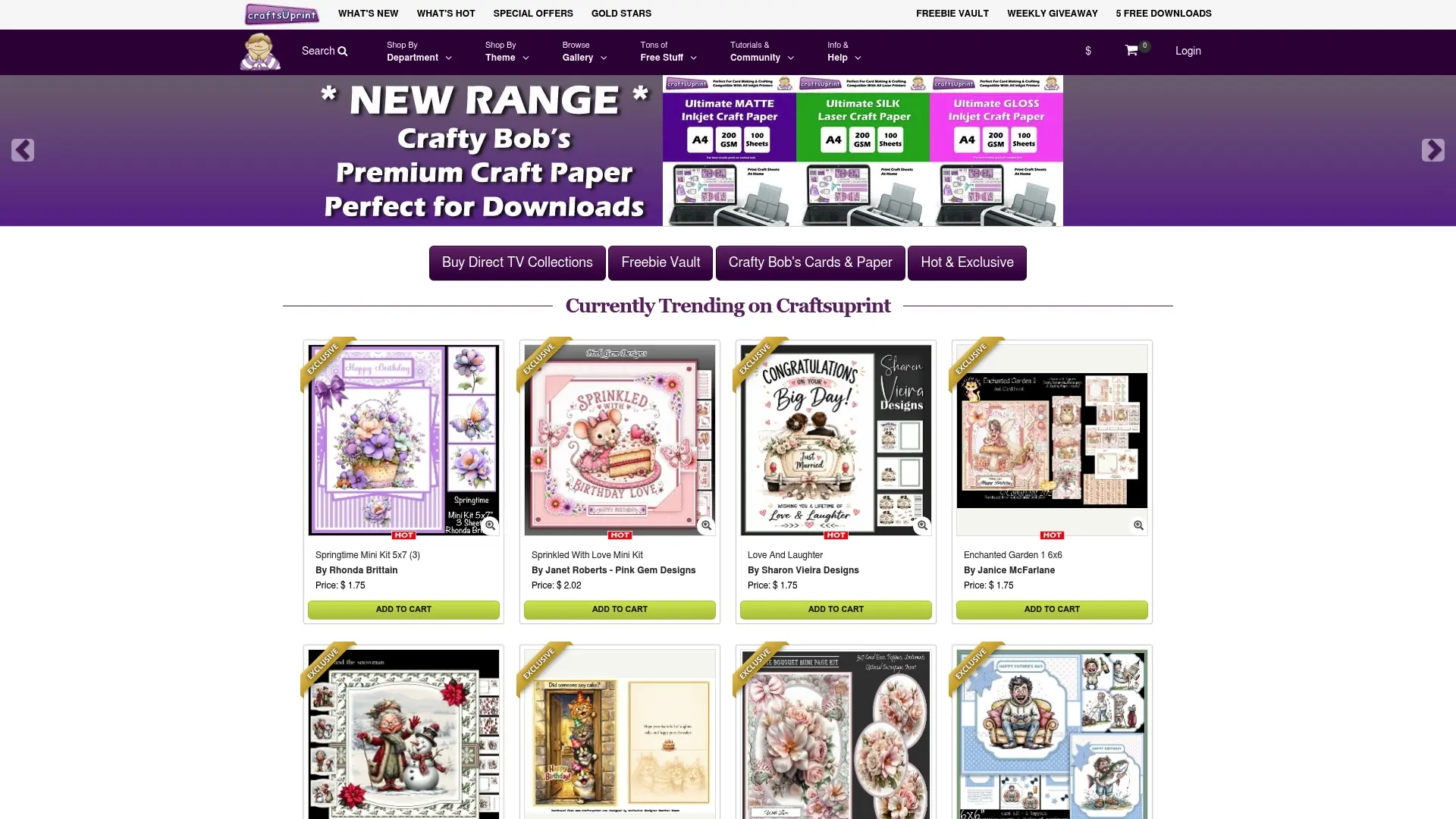
Members can claim a free Create and Craft gift that includes printable resources suited to a range of skill levels. The craft supplies section covers materials for paper crafts, card making, and decorative projects, so you can source what you need without hunting across multiple sites. If you are working through a paper craft tutorial and need a reliable template to practise on, the paper crafts classifieds page lists current options by category. Craftsuprint also hosts a growing library of craft ideas and tutorials that pair well with the formats covered in this article.
FAQ
What is a craft tutorial?
A craft tutorial is an instructional guide, video, or workshop that teaches a specific technique or walks you through completing a project. Formats range from free YouTube videos to paid live workshops and downloadable PDF patterns.
Which type of craft tutorial is best for beginners?
Free video tutorials and beginner starter guides are the most accessible entry points, as many starter projects cost very little and require minimal setup. A written pattern or PDF guide alongside the video helps beginners track their progress accurately.
How do virtual workshops differ from pre-recorded tutorials?
Virtual workshops are live, instructor-led sessions that provide real-time feedback and adapt to each participant’s needs. Pre-recorded tutorials offer flexibility but no feedback, which means errors can go uncorrected.
Why are community forums useful for craft learning?
Community forums capture tacit knowledge and real-world adaptations that official tutorials rarely document. Threads on platforms such as Ravelry and Reddit provide pattern corrections, material substitutions, and troubleshooting advice from crafters who have completed the same project.
Can I learn crafts effectively from social media tutorials alone?
Social media tutorials are useful for discovering techniques and finding inspiration, but they frequently compress or omit steps for visual effect. Pairing them with a written pattern or a longer video tutorial produces more reliable results.