
Role of branding for craft designers: 2026 guide
TL;DR:
- Branding helps craft designers build a recognizable identity that increases sales and customer loyalty.
- Consistent branding boosts conversion rates, enables premium pricing, and establishes trust in crowded markets.
Branding for craft designers is the practice of building a consistent, recognisable identity that communicates who you are, what you make, and why it matters. The role of branding for craft designers extends far beyond a logo or colour palette. It is the business strategy that separates a memorable maker from a forgettable listing on Etsy or any other handmade marketplace. Online craft shops with consistent professional branding realise 25–40% higher conversion rates than those with generic visuals. That gap is not a design preference. It is revenue. A well-built brand identity covers visual consistency, storytelling, packaging, and the emotional impression you leave with every customer who encounters your work.
What benefits does branding bring to craft designers’ businesses?
Branding produces measurable commercial results for independent makers. The numbers are specific enough to plan around.
Higher conversion rates and repeat purchases
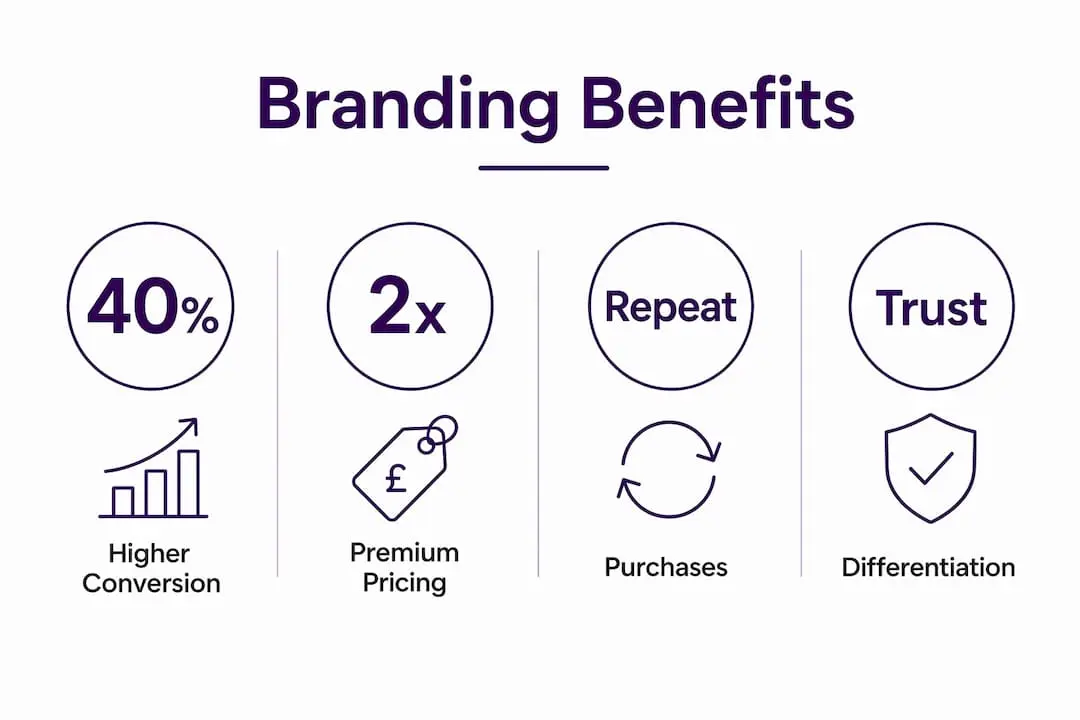
Consistent branding lifts conversion rates by 25–40% for craft shops compared to unbranded equivalents. Shoppers make faster buying decisions when a shop looks and feels coherent. Repeat customers spend 67% more than first-time buyers. Brand recognition is what drives that loyalty. A customer who remembers your packaging, your tone of voice, and your visual style is far more likely to return than one who simply liked a single product.
Premium pricing through story-driven branding
The same handcrafted product can command nearly double the price with story-driven branding compared to an unbranded listing. A ceramic mug listed with a maker’s story, a cohesive shop aesthetic, and branded photography sells for significantly more than an identical mug with a plain white background and no context. That price difference is not irrational buyer behaviour. It reflects the perceived value that branding creates. Customers are not just buying an object. They are buying the story, the maker, and the meaning behind the work.
Trust and differentiation in crowded marketplaces
Branding builds trust and signals professionalism in handmade marketplaces, differentiating your work from mass-produced alternatives. Etsy buyers in particular reward distinctive identities. A cohesive brand signals reliability. It tells a shopper that the person behind the shop is serious, consistent, and worth trusting with their money. Generic visuals do the opposite. They make handmade work look interchangeable with factory output, which is the worst possible outcome for an independent maker.
Here is a summary of the core commercial benefits:
- Conversion uplift: Consistent branding produces 25–40% higher conversion rates.
- Repeat spend: Loyal customers spend 67% more per transaction than new buyers.
- Price premium: Story-driven branding can nearly double the price a product commands.
- Trust signals: Cohesive visual identity differentiates handmade work from mass-produced goods.
- Long-term loyalty: A recognisable brand gives customers a reason to return beyond the product itself.
Pro Tip: Track your shop’s conversion rate before and after any branding update. Even small visual consistency improvements produce measurable results within weeks.
How do craft designers create authentic and consistent brands?
Authenticity is the one competitive advantage that only craft designers can genuinely offer. A factory cannot replicate a maker’s personal story. A corporate brand cannot authentically claim the values of a solo artisan. The question is how to express that authenticity in a way that is also consistent and professional.
Visual identity: the foundation of recognition
Consistency across logos, typography, colour palette, and photography creates the recognition that professional standing requires. This does not mean your brand must look corporate. It means every touchpoint should feel like it belongs to the same person. Choose two or three fonts and use them everywhere. Select a colour palette of four to six colours and apply it across your shop banner, packaging, social media graphics, and product photography backgrounds. Photography style matters as much as any other element. Natural light, consistent backgrounds, and a recognisable composition style build visual memory faster than any logo.
Storytelling as the heart of craft branding
Storytelling centred on the maker’s personal why ensures authenticity and strengthens brand connection with customers. Your About page is not a biography. It is a brand asset. It should answer three questions: why you make what you make, what values guide your work, and what a customer gains by choosing you over anyone else. The same story should appear in shortened form in your shop bio, your packaging inserts, and your social media captions. Repetition across touchpoints is how a story becomes a brand.
Brand touchpoints beyond the shop
Every point of contact with a customer is a branding opportunity. These include:
- Packaging: Tissue paper, stickers, and printed inserts reinforce your visual identity at the moment of delivery.
- Social media: Consistent photo style and caption tone build recognition across Instagram, Pinterest, and Facebook.
- About page: The maker’s story told clearly and personally creates emotional connection before a purchase decision.
- Email communications: Order confirmations and follow-up messages written in your brand voice extend the relationship beyond the transaction.
- Product naming: Names that reflect your aesthetic or values add personality and make listings more memorable.
Pro Tip: Photograph all your products in the same lighting setup and with the same background colour. Customers who visit your shop should immediately recognise your work as a collection, not a random assortment.
The risk most craft designers face is not a lack of personality. It is inconsistency. A beautifully designed shop banner paired with blurry product photos and a generic bio sends a mixed signal. Customers notice the gap even if they cannot name it. Consistent use of typography, photo lighting, and colour palette amplifies maker personality rather than imposing corporate polish. The goal is not to look like a big brand. The goal is to look unmistakably like you, every single time.
DIY branding vs hiring an agency: what suits craft designers?
Independent craft designers face a genuine choice at different stages of their business. DIY branding is not simply a budget decision. It is a scope decision.
What DIY branding actually covers
DIY branding must cover product naming, photography, packaging, and messaging to avoid appearing mass-produced. Many makers assume branding means designing a logo in Canva. The reality is that a logo is the smallest part of the job. Voice, product naming, photography style, packaging design, and the story you tell across every channel are all branding decisions. A maker who invests time in all of these areas can build a strong brand without professional agency support, particularly in the early stages of a business.
When professional support makes sense
Agency support becomes worth considering when a maker has validated their product market and wants sharper positioning for growth. A branding agency brings outside perspective, which is valuable when you are too close to your own work to see how it reads to a stranger. The investment is significant, so the timing matters. Spending on agency branding before you know who your ideal customer is wastes money. Spending on it after you have a clear audience and a proven product range can accelerate growth considerably.
| Approach | Best suited for | Key advantage | Main risk |
|---|---|---|---|
| DIY branding | Early-stage makers | Low cost, authentic voice | Inconsistency across touchpoints |
| Agency branding | Established makers scaling up | Professional positioning | High cost, risk of losing authenticity |
| Hybrid approach | Mid-stage makers | Guided strategy, personal execution | Requires clear brief and direction |
The risk of generic AI-generated branding
Avoid reliance on generic AI-generated logos. Final branding must retain human, authentic craft traces. AI tools can generate logos and colour palettes quickly, but they produce outputs that look like every other AI-generated brand. The handmade market rewards distinctiveness. A brand that looks algorithmically assembled signals the opposite of what craft buyers are seeking. Use AI tools for research, idea generation, or drafting copy. Do not use them as the final word on your visual identity.
Pro Tip: Before investing in agency support or a full rebrand, write down your ideal customer in one paragraph. If you cannot describe them specifically, your branding brief will be too vague to produce useful results.
Defining an ideal collector customer helps command higher prices and reduces burnout by refining your product range. Makers who try to appeal to everyone end up appealing to no one. A focused brand that speaks directly to a specific type of buyer creates stronger loyalty and justifies higher prices. It also makes production decisions easier, because you know exactly what your customer wants and what falls outside your scope.
How does branding transform customer relationships and business growth?
Branding shifts the relationship between a maker and a customer from a single transaction to an ongoing connection. That shift has direct commercial consequences.
Branding is primarily about building context that explains the handmade process, values, and price justification. Without that context, a handmade product is just an object competing on price with mass-produced alternatives. With it, the same product becomes a considered purchase from a maker whose work the customer understands and values. Context is what makes a £45 hand-thrown bowl feel like a bargain and a £6 factory bowl feel inadequate.
Modern consumers use craft purchases to express identity. Strong brands create belonging and long-term loyalty. A customer who buys from a maker whose values align with their own is not just buying a product. They are expressing something about themselves. That emotional investment produces loyalty that no discount or promotion can replicate. It also means your brand narrative is a portable asset. It works on Etsy, on your own website, at craft fairs, and on social media, because the story travels with the work.
The practical benefits of this shift include:
- Faster product launches: An established brand with a loyal audience generates immediate interest for new products.
- Premium pricing: Customers who trust a brand pay more without needing to be convinced.
- Repeat business: Brand loyalty produces returning customers who spend more per visit.
- Word of mouth: Customers who feel a sense of belonging to a brand recommend it to others.
- Resilience: A strong brand weathers marketplace algorithm changes better than an unbranded shop.
Branded narratives transform customer relationships from transactions to long-term connections expressing shared values. The makers who build the most durable craft businesses are not necessarily the most technically skilled. They are the ones whose customers feel they know them. That familiarity is built through consistent, authentic branding over time. Learning to sell craft designs online becomes significantly easier once a brand identity is in place, because every new product launches into an already-receptive audience.
Authenticity is a competitive advantage that only craft designers can genuinely offer through their story-centred brand. No mass manufacturer can replicate the genuine human story behind a handmade product. That is a structural advantage. The makers who use it well build businesses that grow without needing to compete on price.
Key takeaways
Branding for craft designers is the single most effective tool for increasing conversion rates, commanding premium prices, and building the customer loyalty that sustains a long-term business.
| Point | Details |
|---|---|
| Branding drives conversions | Consistent branding produces 25–40% higher conversion rates for craft shops. |
| Repeat customers spend more | Brand recognition drives loyalty; repeat buyers spend 67% more than first-time customers. |
| Story-driven pricing works | A maker’s story can nearly double the price a product commands versus an unbranded listing. |
| Authenticity is a structural advantage | Only craft designers can genuinely offer a human story; use it consistently across all touchpoints. |
| DIY branding covers more than a logo | Product naming, photography, packaging, and voice all form part of a complete brand identity. |
Why I think most craft designers underestimate their biggest asset
Most craft designers I have worked with and observed over the years make the same mistake. They treat branding as something to sort out once the business is “ready.” They focus on making more products, listing more items, and running more promotions. Branding gets pushed to a future version of the business that never quite arrives.
The uncomfortable truth is that branding is not a finishing touch. It is the foundation. A maker with ten products and a clear, consistent brand will outsell a maker with a hundred products and no coherent identity. Every time. The role of social sharing for crafters amplifies this effect. A strong brand makes every shared post more recognisable and every new follower more likely to convert.
What I have seen work consistently is this: amplify your actual personality rather than trying to project a polished corporate image. The makers who succeed are not the ones with the most expensive logos. They are the ones whose customers feel they are buying from a real person with a genuine point of view. Consistency matters more than perfection. A slightly imperfect brand that shows up the same way every day beats a beautiful brand that appears inconsistently.
The warning I give every maker is this: do not let a trend or a generic template define your brand. Trends pass. Templates look like everyone else’s. Your story is the one thing no competitor can copy. Treat it as the business asset it genuinely is, and invest in communicating it clearly across every touchpoint, from your packaging to your About page to the way you respond to customer messages.
Branding is not a project you complete. It is a practice you maintain. The makers who understand that build businesses that last.
— Rob
Craftsuprint resources for craft designers building their brand
Craftsuprint gives independent craft designers the tools and materials to build a brand that looks and feels professional from the first product to the hundredth.
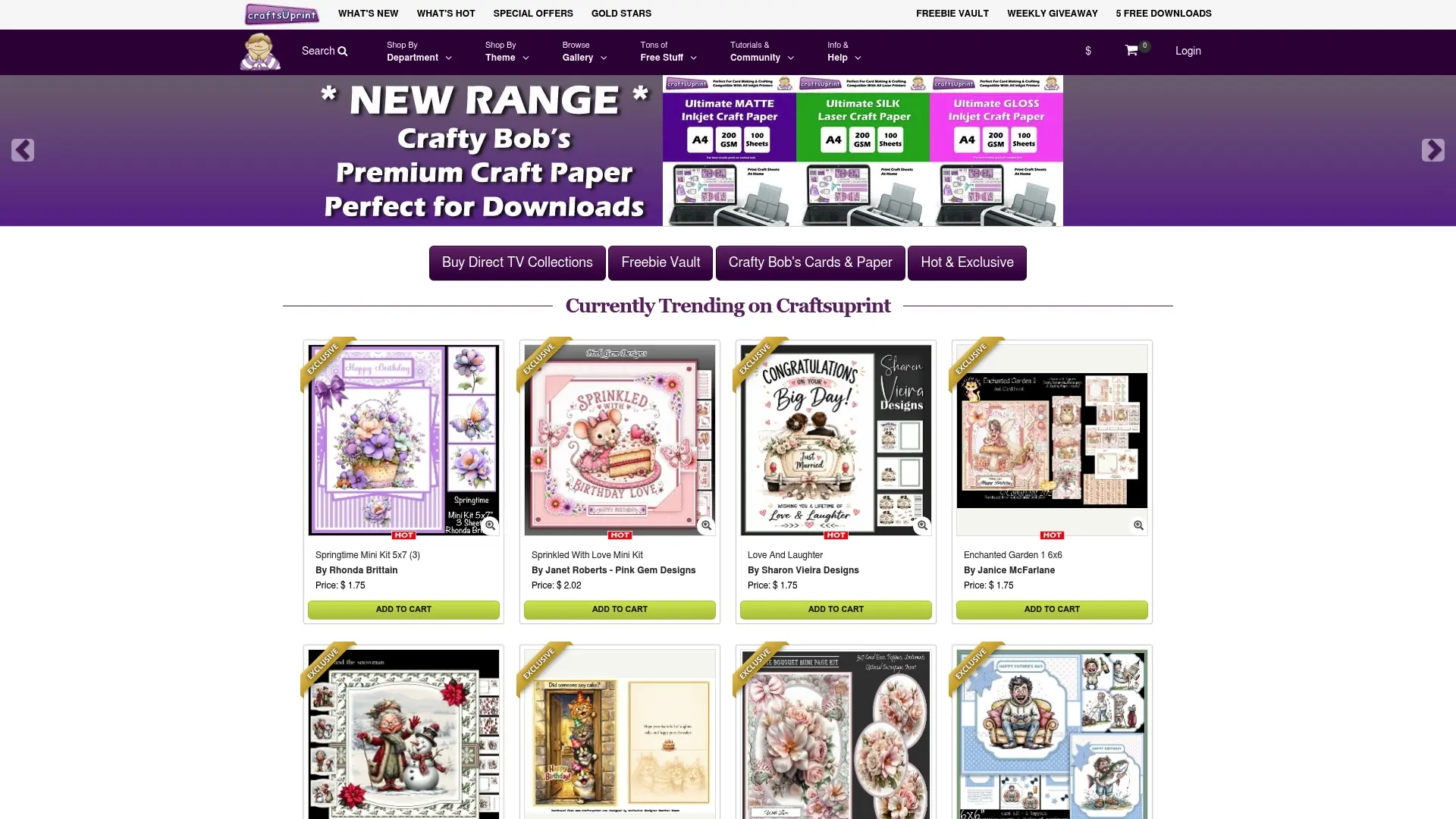
The Craftsuprint marketplace offers an extensive range of craft supplies and tools that support everything from packaging design to product creation. Makers looking to strengthen their visual identity will find decoration materials, paper crafts, and printable resources that bring brand ideas to life. New members can access a free Create and Craft gift as an introduction to the platform’s full range of downloads and resources. Whether you are refining your packaging or building a consistent product collection, Craftsuprint has the materials to support your next step.
FAQ
What is the role of branding for craft designers?
Branding gives craft designers a consistent identity that communicates their values, justifies premium pricing, and builds customer loyalty. It is the business strategy that separates memorable makers from generic listings in competitive marketplaces like Etsy.
How does branding impact craft sales?
Consistent branding produces 25–40% higher conversion rates for craft shops, and repeat customers who recognise a brand spend 67% more than first-time buyers. Story-driven branding can also nearly double the price a product commands compared to an unbranded equivalent.
Should craft designers do their own branding or hire an agency?
Early-stage makers benefit most from DIY branding, which covers voice, photography, packaging, and product naming. Agency support makes sense once a maker has a validated product range and a clear audience, as the investment produces sharper positioning for growth.
Why is storytelling important in craft branding?
Storytelling communicates the maker’s personal values and process, which creates the emotional context that justifies handmade prices. Customers who understand why a maker creates what they create are more likely to buy, return, and recommend.
Can AI tools replace human branding for craft designers?
AI tools are useful for research and idea generation, but generic AI-generated logos and templates produce outputs that look identical to every other AI-assisted brand. Craft branding must retain human, authentic traces to stand out in a market that rewards genuine distinctiveness.