
3 Storage Systems to Match Print Type and Protect Crafters' Printed Papers
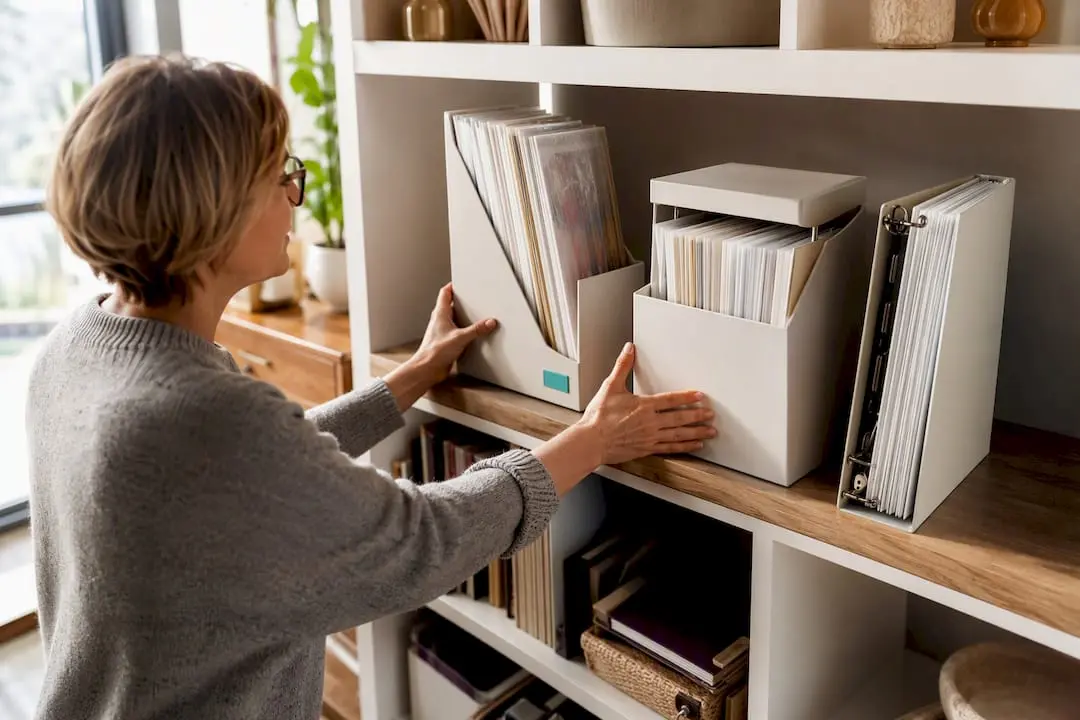
Sort your printed craft sheets by print type first, then house them accordingly: acid-free, PVC-free enclosures for anything long-term, and vertical or shallow flat storage depending on how often you reach for them. Never let inkjet or photo-style prints sit face-to-face with plain paper or vinyl sleeves. Craftsuprint’s printable downloads work well with either system once you’ve decided how often a design earns a spot in your active stash.
TL;DR:
- Proper storage depends on whether the paper is laser-printed toner or inkjet, with inkjet and photo prints requiring more careful handling to prevent smudging and fading.
- Vertical files are ideal for daily-use sheets, shallow boxes suit flat storage for rare or large sheets, and binders work best for themed or curated collections.
- Always choose acid-free, PVC-free enclosures that meet ISO 18902 standards and avoid PVC to prevent chemical reactions damaging your prints over time.
- Store prints flat in stable environments away from direct sunlight and humidity, and handle sheets by edges to prevent fingerprints and smudges.
- Organize by size, color, theme, or use to facilitate quick access, with digital filing matching physical storage to improve workflow efficiency.
Table of Contents
- How should you store printed craft papers?
- Primary storage methods: vertical files, boxes, binders
- Which enclosures and materials keep prints safe?
- How to organise papers by size, colour and project
- Short-term versus long-term storage: what changes
- Handling and maintenance that prevent damage
- Craftsuprint’s take on storing printables well
- Find printables and storage-friendly supplies on Craftsuprint
- Sources
- FAQ
How should you store printed craft papers?
The honest answer depends on two things: what the sheet is printed on, and how often you’ll use it. A laser-printed toner sheet behaves very differently in storage from an inkjet photo print or a specialist fine-art card. Toner is fused to the page and fairly stable. Inkjet ink sits on the surface and can smudge, transfer, or fade if it touches the wrong material.
Once you’ve identified the print type, the storage decision splits into two questions: how do I house it (the enclosure), and where do I keep it (the system). Get the enclosure wrong and even a perfectly organised shelf won’t save your papers from yellowing or ink transfer. Get the system wrong and your papers stay safe but become impossible to find, which for most crafters defeats the point of buying them in the first place.
Plain laser-printed cardstock and standard patterned paper tolerate more casual handling. Inkjet prints, photo paper, and anything described as “fine art” or “specialty” finish need more careful treatment, closer to how you’d store a photograph than a receipt. That distinction should drive every storage decision that follows.
Primary storage methods: vertical files, boxes, binders
Three formats cover almost every crafter’s needs, and picking between them comes down to space, how often you dig through the pile, and what size sheets you’re storing.
Vertical storage (think magazine files or acrylic sorters standing upright) keeps papers visible at a glance and stops the curling that happens when sheets sit under their own weight for months. It also saves your back: you’re not lifting a 40-sheet stack every time you want the one at the bottom. CreateRoom recommends vertical storage specifically for this reason, and it’s the format most cardmakers reach for once their collection grows past a single drawer.
Shallow archival boxes solve a different problem. A 12×12 archival-safe polypropylene box, designed to hold scrapbook paper flat, also fits A4 and smaller formats with room to spare. These suit papers you want kept perfectly flat, such as patterned cardstock or larger printable sheets that would crease if filed vertically.
Binders and sleeves work best for curated sets: a themed collection, a set of matching sentiment sheets, or individual prints you want to flick through like a catalogue. Match the sleeve size to the sheet (standard A4 pockets for full sheets, smaller photo sleeves for 6×6 prints) rather than forcing everything into one pocket size.
- Daily-use project stash: vertical files or open trays for fast access
- Occasional-use library: shallow boxes for flat, protected storage
- Curated or gifted sets: binders with clear sleeves for browsing
Pro Tip: Keep one shallow box reserved purely for “in progress” projects. When it fills up, that’s your cue to finish or file something, not buy another box.
Which enclosures and materials keep prints safe?
Buy anything labelled “acid-free” or “archival” and check it doesn’t contain PVC before it goes near a photo-style print. Two standards do the heavy lifting behind those labels: ISO 16245 and ISO 18902 govern enclosures for photographic and printed materials, and ISO 18902 is the stricter of the two, aimed at specialty and photographic-grade prints rather than everyday paper stock.
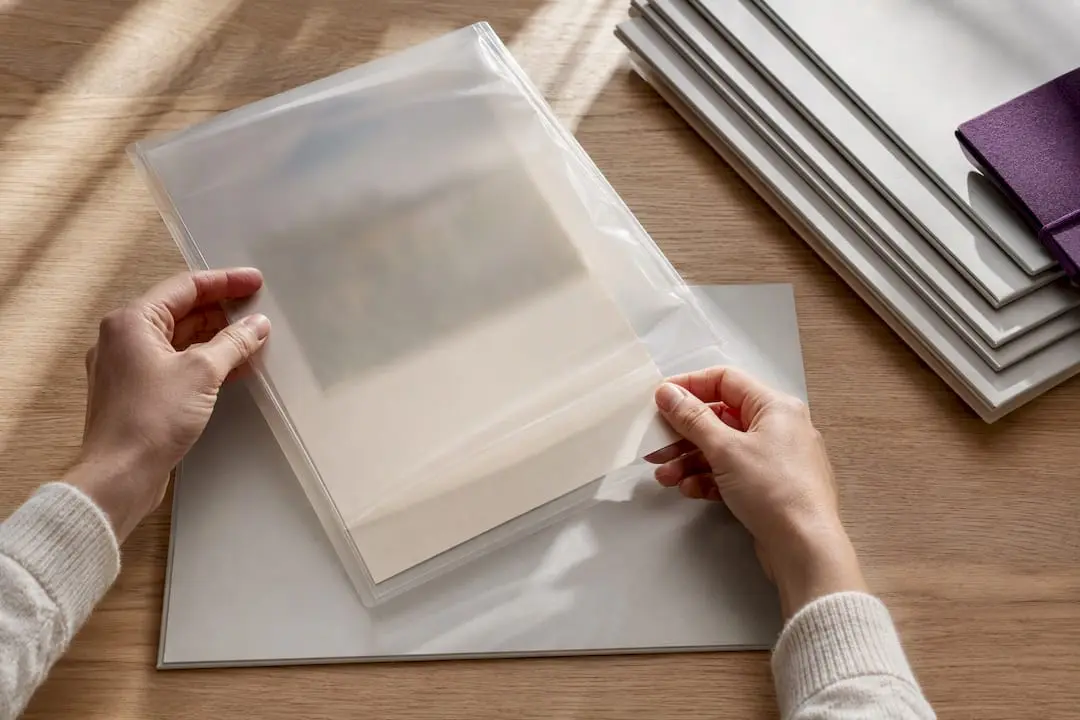
If you’re storing inkjet photo prints, fine-art printables, or anything with a glossy or pigment-heavy finish, ISO 18902 is the benchmark to look for. The Photographic Activity Test (PAT) is the practical shorthand: a product that’s passed PAT testing has been checked for chemical reactions that could fade or discolour a print over time. For plain laser-printed patterned paper, this level of rigour matters less. For anything inkjet or photographic, it matters a lot.
A few material rules are worth memorising rather than checking every time:
- Never use PVC sleeves or boxes; PVC can soften toner and cause it to transfer onto adjacent sheets
- Choose polypropylene (PP) or polyester sleeves over generic “plastic” ones, especially for sensitive prints
- Pick acid-free boxboard or card for any box meant to last years, not months
- Smooth polyester sheeting is the safer choice for direct contact with delicate inkjet surfaces
When you’re shopping, the label usually tells you what you need to know within seconds. “Acid-free,” “archival-grade,” and any mention of PAT testing are the three phrases to scan for. If a product doesn’t say what plastic it’s made from, treat that as a warning sign rather than an oversight.
How to organise papers by size, colour and project
A collection that’s safely stored but impossible to search through still wastes your time. Four sorting axes cover most crafters’ needs, and you don’t need all four at once.
- By size first if you mix formats regularly, so 12×12 sheets, A4 printables, and 6×6 pads don’t get squashed together
- By colour family if you plan projects around a palette, which speeds up matching backgrounds to embellishments
- By theme or collection for anything bought as a set (a Christmas kit, a florals bundle) so it stays together as designed
- By use-case, separating full sheets from pre-cut card fronts, since the two get used at completely different points in a project
Label shelves, dividers, or box lids rather than relying on memory. A simple index card taped to the front of a box, listing what’s inside, saves you opening five boxes to find one design.
For scraps and pre-cut pieces, a binder with clear pockets or a set of small labelled drawers works better than a catch-all bag. Practitioner advice from card makers consistently points to keeping a separate “current project” stash away from the main library, so your working pile doesn’t slowly cannibalise your organised collection.
Short-term versus long-term storage: what changes
Daily-use papers and archive-quality keepsakes don’t need the same treatment, and treating everything as if it needs museum-grade care just slows you down.
For short-term storage, quick-access trays or open magazine files are fine, and it’s acceptable to use ordinary sleeves for sheets you’re actively working through. The trade-off is that you should plan to rotate or upgrade anything you decide to keep long-term, rather than leaving it in a casual sleeve indefinitely.
For long-term storage, move to archival boxes or albums that meet the ISO and PAT guidance above, and store flat where the sheet’s size or weight makes that practical. A design you bought once and used within the month doesn’t need this. A signed print, a rare discontinued pack, or a sentimental set does.
- Keep humidity stable and avoid damp cupboards or attics prone to temperature swings
- Store away from direct sunlight or bright window light, which fades inkjet colour fastest
- Aim for a steady indoor room temperature rather than anywhere near radiators or unheated garages
Pro Tip: If you find yourself hesitating before using a sheet “in case you need it later,” that hesitation is your signal to move it into archival storage rather than keep it in daily rotation.
Handling and maintenance that prevent damage
Most damage to printed craft papers happens through handling, not storage itself. Clean, dry hands and lifting sheets by the edges rather than the middle prevents the oil and grit transfer that eventually shows up as smudging or faint fingerprints.
Never stack inkjet or photo-style prints face-to-face. Use a polyester interleaving sheet or store them printed-side out, back-to-back, to avoid ink transfer between two glossy surfaces.
- Check boxes and binders every few months for dust, silverfish, or damp smells
- Wipe down shelving and box exteriors before restocking rather than after a problem appears
- If you spot adhesive residue bleeding through, small brown spots (foxing), or a musty smell suggesting mould, remove the affected sheet immediately and isolate it from the rest of the collection
- For anything valuable enough to be worth saving, a paper conservator is the right call rather than attempting a DIY fix
Craftsuprint’s take on storing printables well
Digital organisation and physical storage work best together. Craftsuprint’s downloads arrive sorted by theme and kit, which gives you a natural head start: group your printed sheets the same way you filed them digitally, and you’ll find things twice as fast.
Community habits worth borrowing include building a dedicated kit box for each weekly freebie as it’s printed, rather than letting a backlog build up unsorted. Crafters who pre-cut pieces from a kit as soon as they print it, rather than storing full sheets indefinitely, consistently report faster project turnaround. For more on pairing digital downloads with a printed workflow, Craftsuprint’s guide to digital paper crafts covers the organisational side in more depth.
— Rob
Find printables and storage-friendly supplies on Craftsuprint
Once your storage system is sorted, the next question is usually what to fill it with. Craftsuprint’s Create & Craft downloads give you a steady supply of new printable sheets, kits, and templates to slot straight into whichever system you’ve built, whether that’s a vertical file for daily projects or a shallow box for the keepers.
Buying digitally means you control exactly how much you print and when, so your storage never gets ahead of what you can realistically organise. If you’re also stocking up on the physical side, the card and paper supplies section pairs well with printable downloads, giving you matching cardstock without a separate shopping trip. Browse the current Create & Craft download catalogue and start building a stash that fits the storage system you’ve just set up.
Sources
For deeper detail on enclosure standards, see the DP3 Project’s preservation guidance and Altenew’s roundup of 13 craft-paper storage ideas.
- 12x12" Scrapbook paper storage box | WestonBoxes
- What are the best ways to store and organize paper and cardstock? — CreateRoom
FAQ
What’s the best way to store printed craft papers long-term?
Use acid-free, PVC-free boxes or sleeves that meet ISO 18902 guidance, store sheets flat where size allows, and keep them away from direct sunlight and damp.
Can I store inkjet and laser-printed papers together?
Keep them separate where possible; inkjet prints are more sensitive to moisture and pressure, and ideally shouldn’t sit face-to-face with any other printed surface.
Are plastic sleeves safe for craft paper storage?
Polypropylene and polyester sleeves are safe choices; PVC sleeves are not, since PVC can soften toner and cause it to transfer onto nearby sheets.
How do I stop patterned cardstock from curling in storage?
Store it flat in a shallow box rather than rolled or stacked loosely, and avoid humid environments that make paper more prone to warping.
Should I print and store everything at once, or little and often?
Printing in smaller batches as needed, the approach Craftsuprint’s download model supports, keeps your storage system manageable and avoids a backlog of unsorted sheets.