
How to sell digital crafts: your 2026 guide

TL;DR:
- Selling digital crafts involves creating downloadable design files for online marketplaces or personal websites. Success depends on niche selection, value-based pricing, high-quality standards, and consistent catalog expansion. Building a reputable shop requires focus, clear communication, and regular review of analytics to optimize sales strategies.
Selling digital crafts is the practice of creating and distributing downloadable design files, printable templates, or craft kits through online marketplaces or your own website. The market rewards creators who understand product types, pricing psychology, and listing quality. First sales on major marketplaces typically arrive within 2–4 weeks when sellers have 3–10 SEO-optimised listings. That timeline is achievable for most crafters who start with a focused niche and a clear pricing structure. This guide covers how to sell digital crafts profitably, from choosing your product type to writing listings that convert.
How to sell digital crafts: choosing the right product type
The most profitable digital craft products fall into a handful of well-defined categories. Knowing which category suits your skills and the current demand is the first decision you need to make.

Popular product categories
The categories with the strongest, most consistent demand include:
- Printable wall art: Wall art attracts 65,000+ monthly searches, making it one of the best starting points for beginners. The files are straightforward to produce and buyers purchase repeatedly for different rooms or seasons.
- Planners and organisers: Dated and undated planners sell year-round, with spikes in january and september. Buyers value time-saving layouts over decorative complexity.
- Clipart and illustration sets: These appeal to other designers and crafters who need assets for their own projects. Themed sets, such as botanical or vintage, outperform generic collections.
- SVG cut files: These are vector files used with cutting machines. Demand is high among crafters who own machines like the Cricut or Silhouette, and buyers often purchase in volume.
- Card-making kits and paper craft templates: Craftsuprint specialises in this category, offering a ready-made audience of hobby crafters who want print-and-make designs.
- Bundles: Grouping related items into a bundle increases the average order value and gives buyers a reason to choose your shop over a single-item listing.
Why micro-niches outperform broad categories
Narrow micro-niches in style or season attract repeat buyers and build customer lifetime value more effectively than broad categories. A shop focused on “boho floral clipart” will rank faster and convert better than one labelled simply “clipart.” The specificity signals expertise to both buyers and search algorithms. Seasonal micro-niches, such as Halloween SVG files or Christmas card kits, also benefit from predictable annual traffic spikes you can plan around.
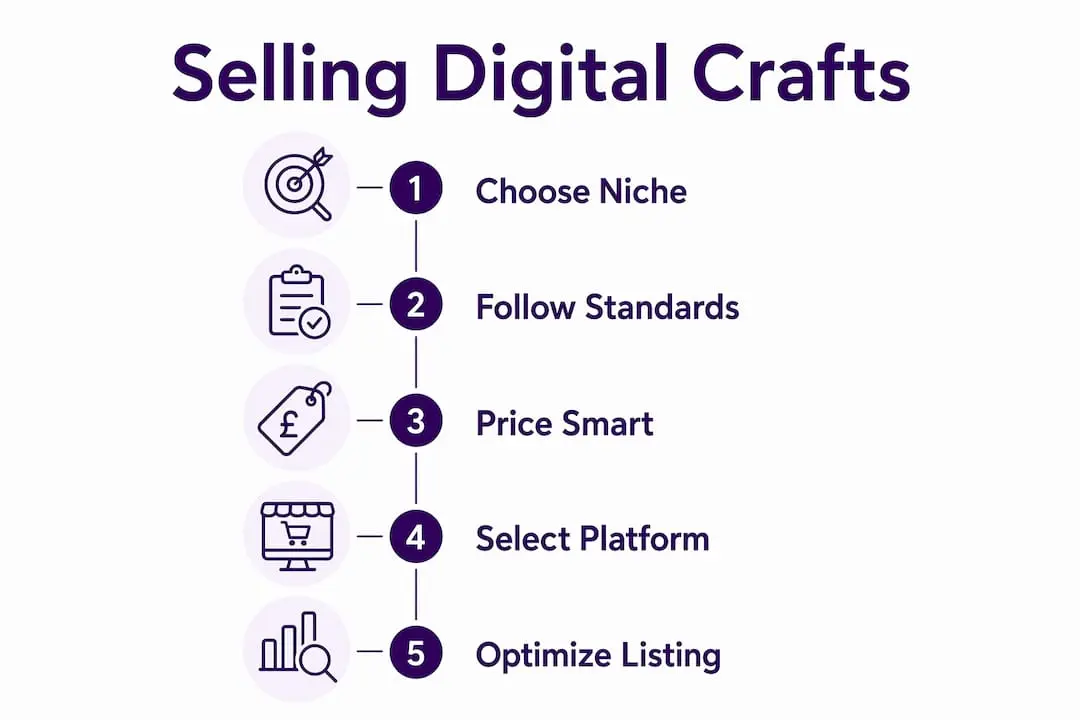
Validate demand before you create. Search your intended niche on any major marketplace and count how many listings appear, how many reviews the top sellers have, and whether new shops are gaining traction. Keyword research tools confirm whether buyers are actively searching for your chosen terms.
Technical standards you cannot skip
High-resolution 300 DPI outputs and standard print sizes such as A4 and US Letter are non-negotiable. Skipping these leads to poor reviews and lost sales. Save files in PDF for print-ready products and PNG for layered or transparent designs. Buyers expect files that work without adjustment. Learn more about craft file formats before you finalise your product range.
Pro Tip: Create a test print of every product before listing it. What looks sharp on screen can print poorly if the resolution or colour profile is wrong. A single bad review citing print quality can suppress your listing for weeks.
How to price digital crafts for maximum profit
Pricing is where most new sellers leave money on the table. The instinct to price low to attract buyers actually works against you.

Understanding value-based pricing
Pricing should reflect the value delivered to the customer, such as time saved or frustration avoided, rather than the time it took you to create the file. A planner that saves a buyer two hours of layout work every week is worth far more than the thirty minutes it took you to design. This is value-based pricing, and it consistently outperforms cost-plus methods for digital products.
Standard pricing tiers in 2026 give you a practical framework:
- Single printables: Price between £3 and £8 for individual files. This tier suits simple wall art, single-page planners, or individual clipart packs.
- Bundles: Price between £8 and £25 for grouped products. A bundle of five coordinating designs or a seasonal card kit collection sits comfortably here.
- Comprehensive kits: Price between £25 and £50 for large, high-value collections. These are multi-file sets with significant creative depth, such as a complete wedding stationery suite or a full year’s planner system.
Anchoring and psychological pricing
Underpricing digital products at £2 or £3 often signals low quality to buyers. Anchoring a higher-priced bundle alongside a mid-range item shifts buyer attention to the mid-range option, increasing your average order value. List a comprehensive kit at £35, a bundle at £15, and a single item at £6. Most buyers will choose the bundle because it feels like the sensible middle ground.
Psychological pricing works at every tier. £4.99 converts better than £5.00 because the perceived gap is larger than the actual one penny difference. Apply this consistently across your catalogue.
Pro Tip: Revisit your prices after your first ten positive reviews. Social proof justifies a price increase of 10–20% without any change to the product itself. Buyers trust a well-reviewed listing and are less price-sensitive when they see others are satisfied.
After a run of positive reviews, raise prices gradually rather than in a single jump. A sudden large increase can trigger a drop in conversion rate. Small, incremental adjustments are less noticeable and easier to reverse if needed. You can read more about craft income opportunities to understand how pricing fits into your broader earning strategy.
Which platforms work best for selling craft downloads?
Platform choice shapes your profit margin, your marketing workload, and how quickly you reach buyers. There is no single right answer, but the trade-offs are clear.
Marketplaces versus self-hosted sites
Marketplaces bring built-in traffic. Buyers are already on the platform searching for products like yours. The cost of that convenience is a listing fee and a transaction fee on every sale. Selling on marketplaces involves listing fees of around $0.20 and transaction fees of around 6.5%, but provides immediate access to an active buyer pool. Self-hosted sites, built on platforms such as Shopify or WooCommerce, keep more profit per sale but require you to drive all your own traffic through SEO, social media, or paid advertising.
| Platform type | Traffic source | Profit per sale | Marketing effort |
|---|---|---|---|
| Marketplace | Built-in audience | Lower (fees apply) | Low to moderate |
| Self-hosted site | You drive all traffic | Higher (no platform fees) | High |
| Specialist craft platform | Niche audience | Variable | Low to moderate |
Choosing the right balance
Most successful digital craft sellers start on a marketplace to build reviews and revenue, then add a self-hosted site once they have a proven catalogue. Running both in parallel is common and sensible. A marketplace listing acts as a discovery tool; your own site handles repeat buyers who already trust your brand.
Craftsuprint operates as a specialist craft marketplace, connecting independent designers with a dedicated audience of hobby crafters. For creators focused on card-making kits, paper patterns, and printable craft projects, a specialist platform reaches buyers who are already motivated to purchase. Read more about why selling craft designs online makes sense as a long-term income strategy.
How to write listings that convert browsers into buyers
A well-made product with a weak listing will not sell. The listing is your sales page, and every element of it carries weight.
Mockups that show your product in use
Mockups showing products in realistic “in-use” contexts improve conversion rates and justify higher prices compared to flat file previews. A wall art print displayed in a styled living room photo communicates quality and aspiration. A planner shown open on a desk with a coffee cup nearby feels tangible and desirable. Flat screenshots of the file itself do neither of these things.
Create at least three mockup images per listing. Show the product in context, show a close-up of the design detail, and show a flat lay of all files included. Free tools such as Canva and Placeit offer mockup templates that require no photography skills.
SEO for titles, tags, and descriptions
- Titles: Lead with the most specific descriptive phrase, such as “Boho Floral Clipart Set, 12 PNG Files, Transparent Background.” Place your primary keyword near the front.
- Tags: Use all available tag slots. Mix broad terms (“floral clipart”) with specific ones (“boho wedding clipart PNG”). Think about what your buyer types, not what you would call the product.
- Descriptions: Open with a plain-English summary of what the buyer receives. Follow with the file details: formats, sizes, resolution, and number of files. Close with clear download instructions.
Clear, detailed listings that state the digital nature, file formats, sizes, and what buyers receive reduce refund rates and increase buyer confidence. A buyer who knows exactly what they are getting before purchase is far less likely to request a refund after.
Pro Tip: Read your listing description aloud before publishing. If you stumble over a sentence or find yourself confused by your own instructions, rewrite it. Buyers skim listings quickly, so clarity beats cleverness every time.
Growing your catalogue over time
Successful shops grow from 3–10 listings to 20–30+ related products to gain niche authority and algorithmic favour. Each new listing is a new entry point for buyers searching different terms. A shop with 25 coordinated products in the same niche signals depth and expertise. Buyers who find one product they like will browse the rest of your catalogue. Explore the types of craft downloads available to get ideas for expanding your own range.
Common mistakes that stall digital craft sales
Most sellers who struggle make the same handful of errors. Recognising them early saves months of frustration.
- Underpricing from the start. Setting prices at £2 or £3 signals low quality before a buyer even opens your listing. Start at a fair value-based price and adjust downward only if data supports it, not out of anxiety.
- Poor file quality. A blurry print or a file that does not open correctly generates a negative review that is very difficult to recover from. Test every file on multiple devices before listing.
- Ignoring listing SEO. A beautiful product buried on page ten of search results earns nothing. Spend as much time on your title and tags as you do on the design itself.
- Expecting instant results. Building a profitable digital craft shop takes consistent effort over months. Sellers who quit after two weeks with three listings never give the algorithm time to index and rank their work.
- Vague listing descriptions. Buyers need to know exactly what they are purchasing. Ambiguity about file formats, sizes, or whether a product is physical or digital leads to disputes and refunds.
“The sellers who build sustainable income from digital crafts are not the ones with the most talent. They are the ones who treat their shop like a business: consistent listings, clear communication, fair pricing, and patience. Talent gets you started; process keeps you going.”
Managing customer expectations clearly in your listings is not just good practice. It is the single most effective way to reduce after-sale problems and protect your shop’s reputation.
Key takeaways
Selling digital crafts successfully requires a combination of niche focus, value-based pricing, quality file standards, and consistent catalogue growth across the right platforms.
| Point | Details |
|---|---|
| Choose a micro-niche | Focus on a specific style or season to attract repeat buyers and rank faster in search. |
| Price on value, not effort | Base prices on time saved for the buyer, not hours spent creating the file. |
| Meet technical standards | Deliver 300 DPI files in PDF or PNG at standard print sizes to avoid negative reviews. |
| Write clear, detailed listings | State file formats, sizes, and download instructions to reduce refunds and build trust. |
| Grow your catalogue consistently | Expand from 3–10 listings to 20–30+ related products to build niche authority over time. |
What I have learned from watching digital craft shops grow
The advice that gets repeated most often, “just list more products,” is correct but incomplete. Quantity without coherence does not build a brand. The shops I have seen grow fastest share one trait: every product they add reinforces the same niche identity. A buyer who purchases a boho floral clipart set and returns six months later expects to find more boho floral products, not a random mix of Christmas SVGs and minimalist planners.
Pricing confidence is the other thing most new sellers lack. I have watched creators undercharge for genuinely excellent work because they feared no one would pay more. The fear is understandable, but the data is clear. Underpricing leads to negative perceptions, and mid-range items anchored by a higher-priced option consistently outperform low-priced single items. Charge what the product is worth, present it well, and trust that buyers who value quality will find you.
Social media is worth using, but not as a primary sales channel. Pinterest works particularly well for digital crafts because pins have a long shelf life and drive search traffic for months after posting. Use it to reinforce your listings, not to replace them. Your listing SEO does the heavy lifting; social media amplifies it.
The most underrated habit in this space is reviewing your own shop analytics every fortnight. Which listings get views but no sales? That is a pricing or mockup problem. Which listings convert well but get few views? That is a title and tag problem. The data tells you exactly where to focus your energy, if you look at it regularly.
— Rob
Resources for digital crafters on Craftsuprint
Craftsuprint is a dedicated home for hobby crafters and independent designers who want to create, share, and sell printable craft projects.
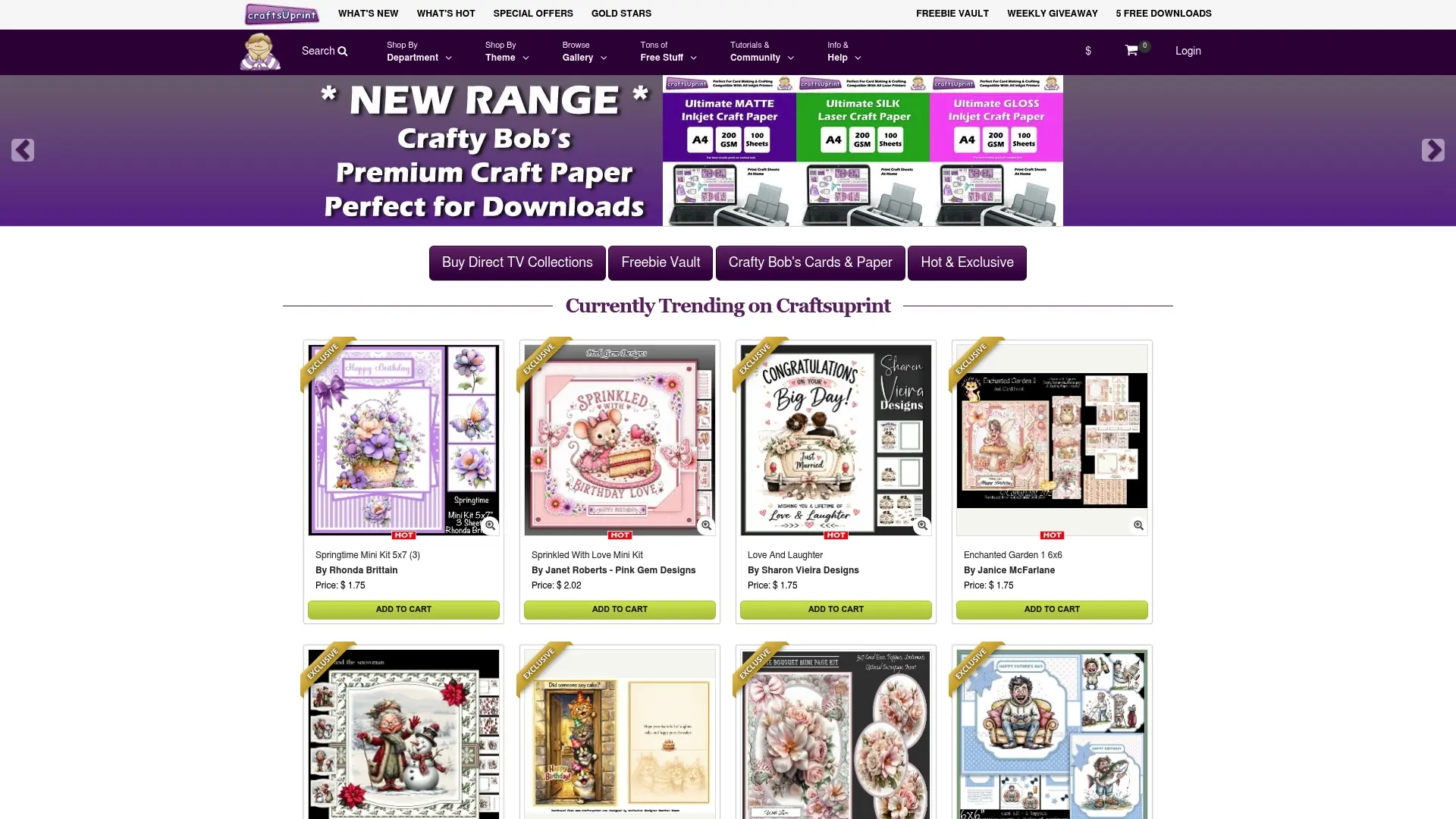
Whether you are building your first digital product range or looking to expand an existing catalogue, Craftsuprint offers a supportive community alongside a curated marketplace. Members can claim a free craft members gift to get started, and the platform’s classifieds section lists craft supplies to complement your digital projects. The Craftsuprint Gold Star programme also gives independent designers a structured way to earn income from their designs within a niche audience that is already motivated to buy.
FAQ
How long does it take to make a first sale?
First sales typically occur within 2–4 weeks when a seller has 3–10 SEO-optimised listings on a major marketplace. Fewer listings or weak SEO extends that timeline significantly.
What is the best price for a single digital printable?
Standard pricing for single printables sits between £3 and £8, depending on complexity and perceived value. Pricing below £3 often signals low quality to buyers and reduces conversion rates.
Do I need a website to sell digital crafts?
A dedicated website is not required to start. Marketplaces and specialist platforms like Craftsuprint provide built-in traffic and a ready audience. A self-hosted site becomes worthwhile once you have an established catalogue and repeat buyers.
What file formats should I use for digital crafts?
PDF is the standard for print-ready products, and PNG works best for designs with transparent backgrounds or layered elements. All files should be exported at 300 DPI to meet professional print standards.
How many products do I need to build a profitable shop?
Start with 3–10 listings in a focused niche, then expand to 20–30+ products as you gain traction. A larger, coherent catalogue builds niche authority and improves your visibility in marketplace search results.