
Explaining categorised craft products: a 2026 guide

TL;DR:
- Categorised craft products are organized into a clear, hierarchical taxonomy based on type, material, and attributes, simplifying browsing and filtering. Proper category structuring ensures mutual exclusivity and accuracy, enhancing user experience and search visibility. Using type-based categories with attribute filtering, and documenting simple rules, helps maintain an efficient, adaptable marketplace.
Categorised craft products are craft supplies and finished items organised into a structured hierarchy based on type, material, and attributes, making it faster and easier to find exactly what you need for your next project. Whether you shop on Etsy, browse Craftsuprint’s digital downloads, or stock a physical craft room, explaining categorised craft products means understanding the taxonomy that sits behind every filter, tag, and product listing. That taxonomy is not arbitrary. It follows clear rules that determine which items sit together, which attributes describe them, and how a crafter navigates from “I need paper” to “I need 300gsm white cardstock for A5 card making.” Get the categories right and the whole shopping experience clicks into place.
How craft product categories are structured in practice
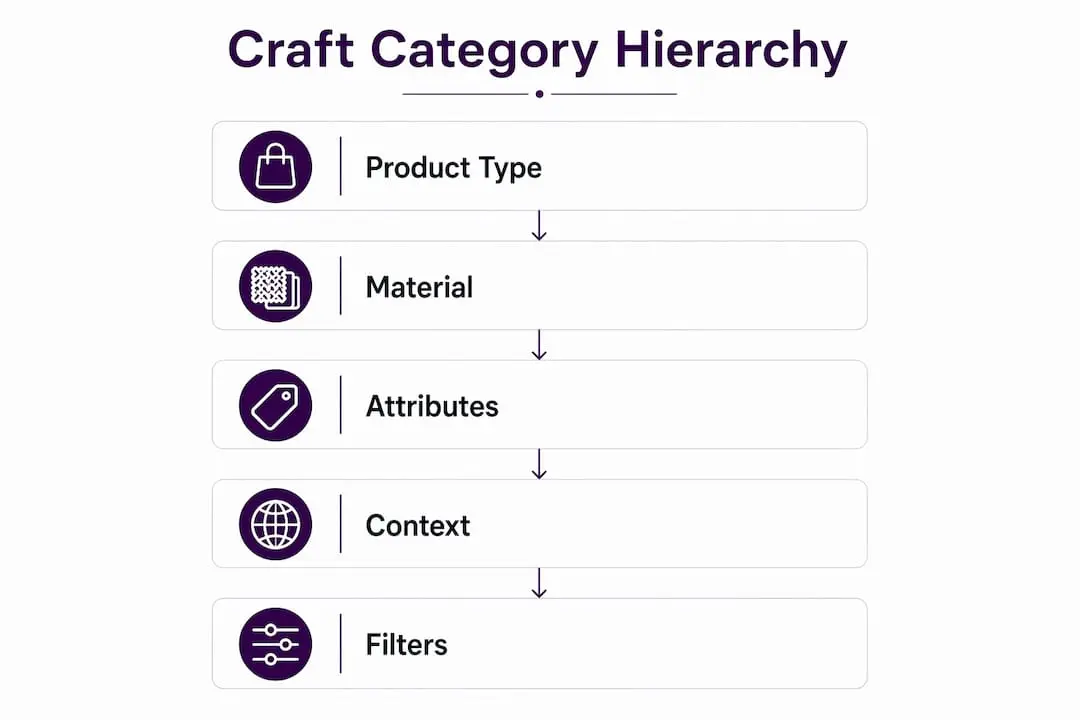
The industry term for this organised system is product taxonomy, and it works as a hierarchy. A well-structured taxonomy typically has three to five levels of depth, narrowing from a broad parent category down to a specific product type. This matters because each level you descend gives you more precision, fewer irrelevant results, and a cleaner shopping path.
A practical craft taxonomy might look like this:
- Craft supplies (level 1, broadest)
- Paper and card (level 2, material family)
- Cardstock (level 3, product type)
- Textured cardstock (level 4, surface finish)
- Embossed white cardstock, A5, 300gsm (level 5, specific product)
Each step down is mutually exclusive. A sheet of embossed white cardstock belongs in exactly one path. It does not also live under “Wedding supplies” or “Scrapbooking paper,” even if crafters use it for both purposes. Mutual exclusivity is the structural rule that prevents a catalogue from becoming chaotic, because once products can sit in two categories simultaneously, filters stop working reliably and shoppers lose confidence in the results they see.
Category naming also carries weight. Names should describe what the product is, not what it is for. “Ribbon” is a category name. “Wedding ribbon” is not, because the same ribbon serves birthdays, gift wrapping, and quilting. Occasion belongs in the attributes layer, not the category name itself.

Edge cases are inevitable. A stamp set that includes both ink pads and rubber stamps could plausibly sit under “Stamps” or “Ink and colouring.” The rule is to assign it to the category that reflects its primary function, then use attributes to flag the secondary components. Clear written category rules, documented and applied consistently, are what separate a manageable catalogue from one that grows into a mess.
Pro Tip: Write your category rules down before you start listing products. A single sentence per category, stating what belongs and what does not, saves hours of reclassification later.
Why material and attributes define what you are actually buying
Material is the single most important filterable attribute in craft product categories because it determines what a product can do. A crafter searching for wire for jewellery making needs to know whether that wire is sterling silver, copper, or aluminium before anything else. The difference between sterling silver and 925 silver is, in fact, no difference at all. They are the same alloy. But if a seller lists one product as “sterling silver wire” and another as “925 silver wire,” a shopper filtering by material may miss one entirely. Consistent, controlled material labelling solves this.
Attributes such as material, technique, and use-case enhance product data structure for artisan sellers, avoiding keyword overload and supporting consistent retrieval. The key distinction is between what belongs in the category and what belongs in the attribute layer:
- Material: paper, fabric, metal, wood, resin, yarn
- Colour: white, kraft, navy, multicolour
- Technique: stamping, decoupage, macramé, embroidery
- Style: vintage, botanical, geometric, Scandi
- Occasion: Christmas, birthday, wedding, everyday
- Size or weight: A4, A5, 300gsm, 4mm, 10m
- Care or usage: heat-resistant, water-activated, acid-free
None of these attributes should form a permanent top-level category. Style, in particular, is a trap. Trends shift. “Cottagecore” is popular in 2026; it may be irrelevant by 2028. Using style as a multi-value filterable tag rather than a category avoids structural debt and adapts better to evolving trends. The category tree stays stable; the tags flex with the market.
On marketplaces like Etsy, selecting the precise leaf-level category unlocks category-specific attributes including material, colour, and occasion, directly affecting which browse pages and filters buyers see. Choosing a vague parent category instead of the most specific available one is one of the most common mistakes craft sellers make, and it costs them visibility.
Type-based vs context-based category structures: which works better?
The two dominant approaches to organising craft product categories are type-based and context-based structures. Understanding the difference helps both shoppers and sellers make sense of why some catalogues feel intuitive and others feel frustrating to browse.
| Approach | Definition | Best used as | Example |
|---|---|---|---|
| Type-based | Categories defined by what the product physically is | Primary taxonomy structure | “Adhesives” > “Double-sided tape” |
| Context-based | Categories defined by where or when the product is used | Filterable attribute or tag | “Christmas crafts,” “Wedding décor” |
| Hybrid misuse | Context used as a top-level category | Causes overlap and confusion | “Christmas” containing paper, ribbon, and stamps |
| Correct hybrid | Type-based structure with context as filter | Recommended approach | “Paper” filtered by “Occasion: Christmas” |
For ecommerce taxonomies, organising primarily by product type and treating context as filterable attributes avoids category conflict and improves both navigation and SEO. The furniture industry learned this the hard way. A sofa is a sofa whether it sits in a living room or a home office. Placing it under “Living room furniture” means it disappears when someone searches “home office seating,” even though it is a valid result. The same logic applies to craft supplies.
A ball of chunky merino yarn is a yarn product. It is also relevant to knitting, crochet, and weaving. It suits winter projects and could appear in a Christmas gift guide. But its primary category is “Yarn > Chunky weight > Merino wool.” Everything else is a tag. This structure means the product surfaces in every relevant filtered search without needing to be listed multiple times under different categories.
The SEO benefit is significant. Category pages built around product types carry stable, high-intent search terms. “Cardstock for card making” is a consistent search phrase. “Christmas card making supplies” spikes in October and drops in January. A type-based category page for cardstock earns authority year-round and can be filtered by occasion when seasonal traffic arrives.
How to write category explanations that actually help crafters
Knowing the taxonomy structure is one thing. Writing it clearly for a crafter who just wants to make a birthday card is another. The most effective product listings and category descriptions follow a layered model that moves from the most critical information to the most contextual.
The best craft product listings state product type, material, and standout attribute first, then include the maker story and practical care or shipping details. This structure serves both human shoppers and AI-powered search tools, which increasingly parse listings to answer conversational queries like “What cardstock works best for watercolour stamping?”
A practical layered description for a craft product works like this:
- Layer 1, the summary: Product type, material, key specification. “A5 white cardstock, 300gsm, smooth finish, acid-free.” This is what the shopper needs to decide if the product is relevant.
- Layer 2, the maker or product story: Why this product exists, what makes it worth choosing, any unique production detail. “Sourced from sustainably managed forests and cut to precise A5 dimensions for consistent card making results.”
- Layer 3, transactional details: Pack size, care instructions, shipping weight, customisation options. Structured with clear labels, not buried in a paragraph.
Structured listings aid AI-based discovery and human decision-making alike, particularly as conversational shopping tools become more common. A listing that buries the material in sentence four will not surface in a voice search asking for “acid-free white cardstock.”
One nuance that trips up many craft sellers and shoppers alike: craft supplies differ from finished handmade products, and clarifying this boundary in categories prevents buyer confusion about product purpose. A card making kit is a supply. A completed handmade birthday card is a finished product. Both are legitimate craft items, but they belong in separate category branches. Kits and blanks sit in supply categories; completed items sit in finished goods categories. Mixing the two creates mismatched buyer expectations and returns.
Category pages benefit from short supporting copy of around 100 to 300 words that helps both shoppers and search engines understand the scope of that category. This copy is not a product description. It is a brief orientation: what types of products live here, who they are for, and what distinguishes them from adjacent categories. Craftsuprint’s digital download categories, for example, benefit from a short note clarifying that products are printable files rather than physical goods, which sets accurate expectations before a shopper clicks through.
Pro Tip: When writing category copy, model a decision path. Start with product type and material, then address constraints such as dimensions, care, and shipping. This mirrors how crafters actually think when choosing supplies.
Key takeaways
Craft product taxonomy works best when categories are defined by product type, attributes handle context and style, and every listing leads with the most critical information first.
| Point | Details |
|---|---|
| Use a three-to-five level hierarchy | Narrow from broad category to specific product type, keeping each path mutually exclusive. |
| Keep material as a filterable attribute | Consistent material labelling unlocks filters and improves discoverability on marketplaces like Etsy. |
| Separate type-based categories from context | Occasion, style, and room belong as tags, not permanent top-level categories. |
| Lead listings with type, material, specification | Shoppers and AI tools both retrieve products faster when critical data appears first. |
| Distinguish supplies from finished products | Kits and blanks belong in supply categories; completed items need their own separate branch. |
Where most crafters and sellers go wrong with categories
The most common mistake I see is treating categories as a filing system rather than a navigation tool. People build a category called “Christmas” and stuff paper, ribbon, stamps, and finished cards into it because they all feel Christmassy. That works for a physical drawer in a craft room. It fails completely in a digital catalogue, because a shopper filtering for “paper” will not find your Christmas cardstock if it lives under “Christmas” rather than “Paper.”
The second mistake is creating categories for every style trend that comes along. I have watched sellers build entire category branches around aesthetics that were popular for eighteen months and then faded. Rebuilding a taxonomy is genuinely painful work. The fix is simple: treat style as a tag from the start, and your category tree stays clean regardless of what trend arrives next.
What I find most crafters underestimate is the value of written category rules. Not a complex document. Just a sentence or two per category: “This category contains unfinished paper blanks and cardstock sheets. Completed cards go in Finished Products > Cards.” That sentence prevents a hundred wrong placements and saves the time spent correcting them later.
The attribute layer is where the real power sits. When a crafter on Craftsuprint can filter digital downloads by technique (decoupage, stamping, iris folding), occasion (birthday, Christmas, sympathy), and format (A4, A5, square), they reach the right product in three clicks rather than thirty. That is not a small improvement. It is the difference between a satisfying browse and an abandoned session.
— Rob
Find your next project on Craftsuprint
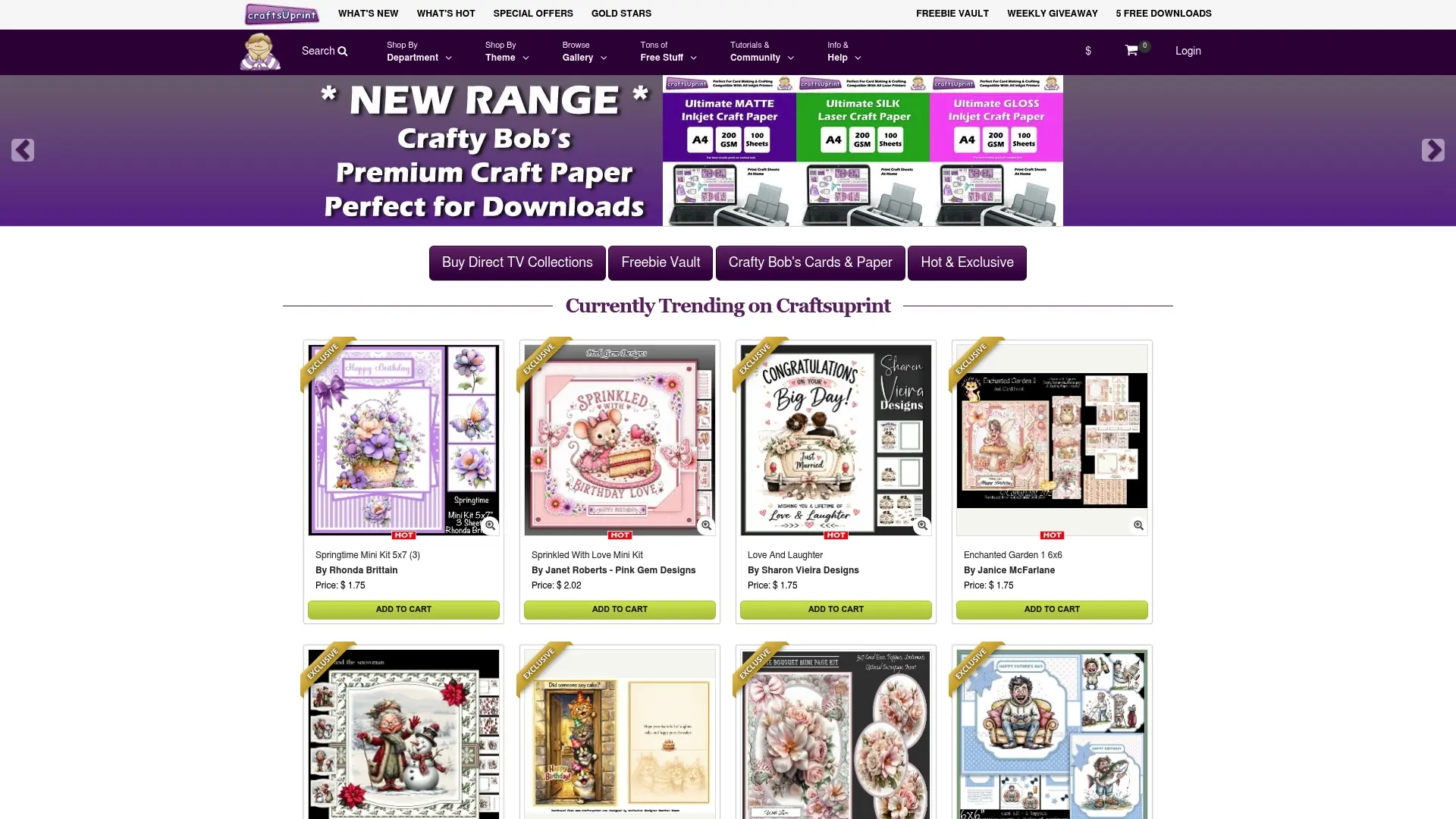
Craftsuprint organises thousands of digital craft downloads into clear, browsable categories covering card making, paper crafts, decoupage, and more, so you spend less time searching and more time creating. Every product is a ready-to-print digital file, clearly labelled by type, technique, and occasion. Tutorials sit alongside the downloads, and weekly freebies mean there is always something new to try. Whether you are planning a birthday card, a seasonal decoration, or a full paper craft project, Craftsuprint’s well-structured catalogue makes it straightforward to find exactly the right materials for the job.
FAQ
What are categorised craft products?
Categorised craft products are craft supplies and finished items organised into a structured taxonomy by type, material, and attributes, making them easier to browse, filter, and purchase. The system typically uses three to five levels, from broad category down to specific product.
Why does material matter so much in craft categories?
Material is the primary filterable attribute because it determines what a product can physically do. Consistent material labelling, such as distinguishing cotton from linen or sterling silver from base metal, directly affects which search filters appear and which products a shopper finds.
What is the difference between a category and an attribute?
A category defines what a product is and forms the permanent structure of a catalogue. An attribute describes a variable quality such as colour, occasion, or style, and works best as a filterable tag rather than a fixed category branch.
Should craft supplies and finished products share the same category?
No. Craft supplies, kits, and blanks belong in separate category branches from completed handmade items. Mixing the two creates buyer confusion about whether they are purchasing something ready to use or something that requires further work.
How long should category page copy be?
Category page copy works best at 100 to 300 words. This is enough to explain the scope of the category to both shoppers and search engines without overwhelming the page with text that competes with the product listings themselves.