
Eco-friendly card printing made easy for UK crafters
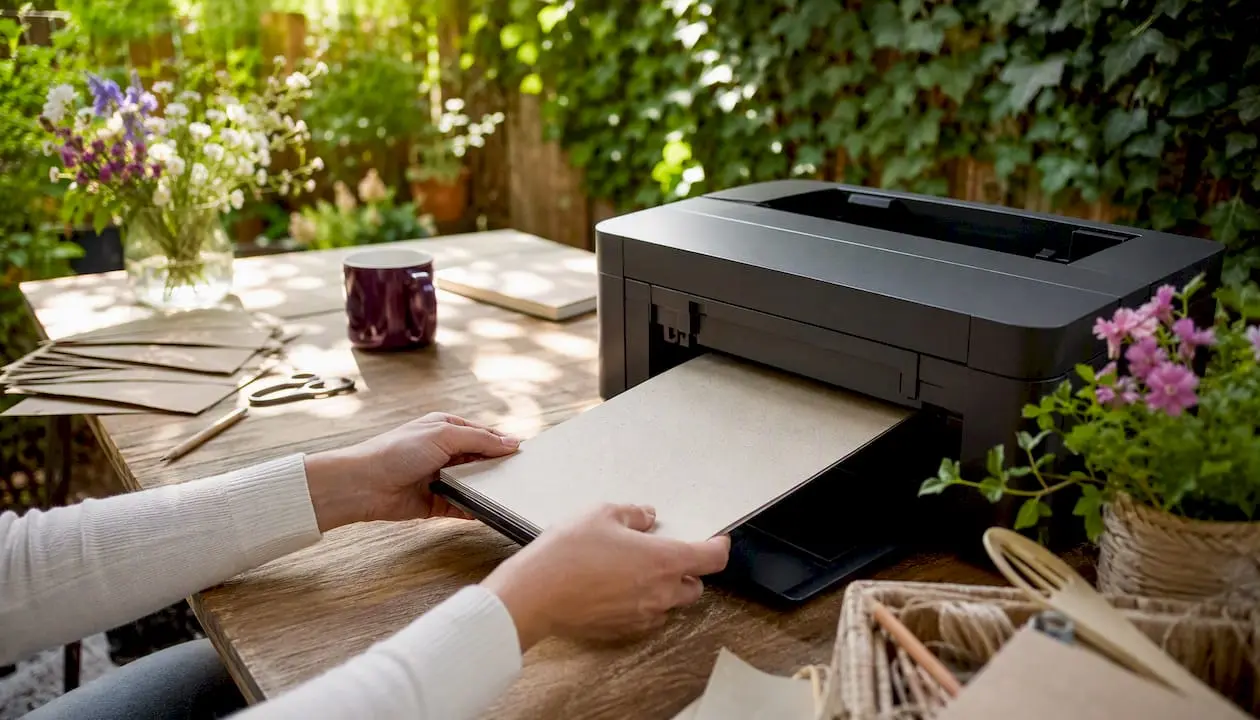
That single combination covers the biggest environmental wins available to a home crafter.
Three things to buy first:
-
A sample pack of 100% recycled, uncoated card (A4 or A3 cut sheets, 250–300gsm) from a UK specialist such as Antalis or Recycled Papers
-
Printable card templates from Craftsuprint, sized and pre-creased for your chosen format
-
Pigment inkjet cartridges or colour laser toner that matches your printer type
Digital short-run printing eliminates plate set-up waste and lets you print only what you need, when you need it. Pair that with PCR or FSC® stock and you close the loop on both process and material.
Key takeaways
Choosing uncoated PCR or FSC® certified stock, pigment or toner inks, and plastic-free envelopes gives UK home crafters the most complete eco-friendly card printing setup available without a commercial press.
| Point | Details |
|---|---|
| Choose PCR or FSC® stock | Uncoated 250–350gsm recycled board prints sharply and stays fully recyclable. |
| Skip all plastic finishes | Laminates and UV coatings prevent recycling; uncoated stock avoids this entirely. |
| Run test proofs every time | A single draft proof on your chosen eco stock prevents wasted full batches. |
| Acclimatise paper before printing | Leave sheets 24–48 hours in your print room to reduce misfeeds on recycled boards. |
| Use Craftsuprint for templates | Pre-creased, CMYK-ready downloads reduce file-setup errors and wasted sheets. |
Table of Contents
- What does eco-friendly card printing actually mean for home crafters?
- How to choose genuinely eco-friendly card stock
- Which home printing method reduces waste most?
- Which inks, finishes and envelopes keep cards recyclable?
- How to set up files and avoid wasted prints
- Where to buy eco paper and printable templates in the UK
- Pre-print checklist: run through this before every batch
- Why this approach works better than the alternatives
- Craftsuprint: templates and supplies for sustainable home card making
- Sources
- FAQ
What does eco-friendly card printing actually mean for home crafters?
This guide is about printable templates, home digital printing workflows, and eco paper supplies. It is not about commercial print services that produce and post finished cards on your behalf. That distinction matters because the actions available to you are completely different.
For home crafters, the sustainability signals worth checking are:
- PCR (post-consumer recycled): paper made from material that has already been used and collected, which has stronger circular-economy credentials than pre-consumer recycled (factory offcuts that never reached a consumer)
- FSC® chain of custody: guarantees responsible forest management through every step of the supply chain
- EU Ecolabel / Cradle to Cradle: third-party environmental certifications you may see on premium stocks
- Carbon Balanced Paper / Carbon Balanced Printer: a World Land Trust scheme some UK suppliers participate in
Commercial litho printing and long-run workflows are out of scope here. If you are printing 20 cards at home, those processes are irrelevant to your decisions.
Pro Tip: Order two or three different sample packs before settling on a stock. Run a single test sheet on each before buying a full ream. The five minutes this takes saves far more paper than any other step in the process.
How to choose genuinely eco-friendly card stock
PCR vs pre-consumer recycled
Post-consumer recycled (PCR) paper is made from collected waste that has already served its original purpose. Pre-consumer recycled uses factory offcuts that never left the production chain. PCR has the stronger environmental case because it diverts material that would otherwise go to landfill or incineration.
Modern 100% recycled boards are engineered to hold toner and deliver sharp images, so you are not trading quality for conscience. Stocks like Teknocard 1 Recycled 100% carry FSC® Mix certification and are built for digital toner printing, making them a solid fit for folded greeting cards at heavier weights.
Tree-free and novelty alternatives
- Seed paper: embedded with wildflower or herb seeds; the recipient plants the card after use. Appropriate for keepsakes and wedding stationery. Printer compatibility varies, so always test a sample sheet first — seed paper can be planted after use but requires testing for home printer suitability.
- Bagasse: made from sugarcane fibre; gives a warm, slightly textured finish suited to rustic or botanical designs
- Cotton and hemp: durable, naturally acid-free, and compostable; higher cost but excellent for premium ranges
- Bamboo: fast-growing crop with lower land impact than virgin wood pulp
Recommended GSM weights
For folded A5 or A6 finished cards, 250–350gsm works well. A4 or A3 sheets for home folding typically sit at 200–300gsm, depending on your printer’s feed path. A 200gsm smooth white A4 card is printer-friendly for many home models, but check your own machine’s maximum GSM specification before attempting anything thicker.
Always choose uncoated or natural finishes. Coated and laminated surfaces often prevent recycling and composting entirely.
Pro Tip: Leave paper to acclimatise in your print room for 24–48 hours before printing. Recycled boards absorb moisture from the air, and a sheet that has adjusted to room temperature feeds far more reliably than one straight from a cold delivery box.
Which home printing method reduces waste most?
Digital printing eliminates plate set-up waste and lets you produce exactly the quantity you need. For home crafters, that means inkjet or laser, printing on demand rather than holding stock.
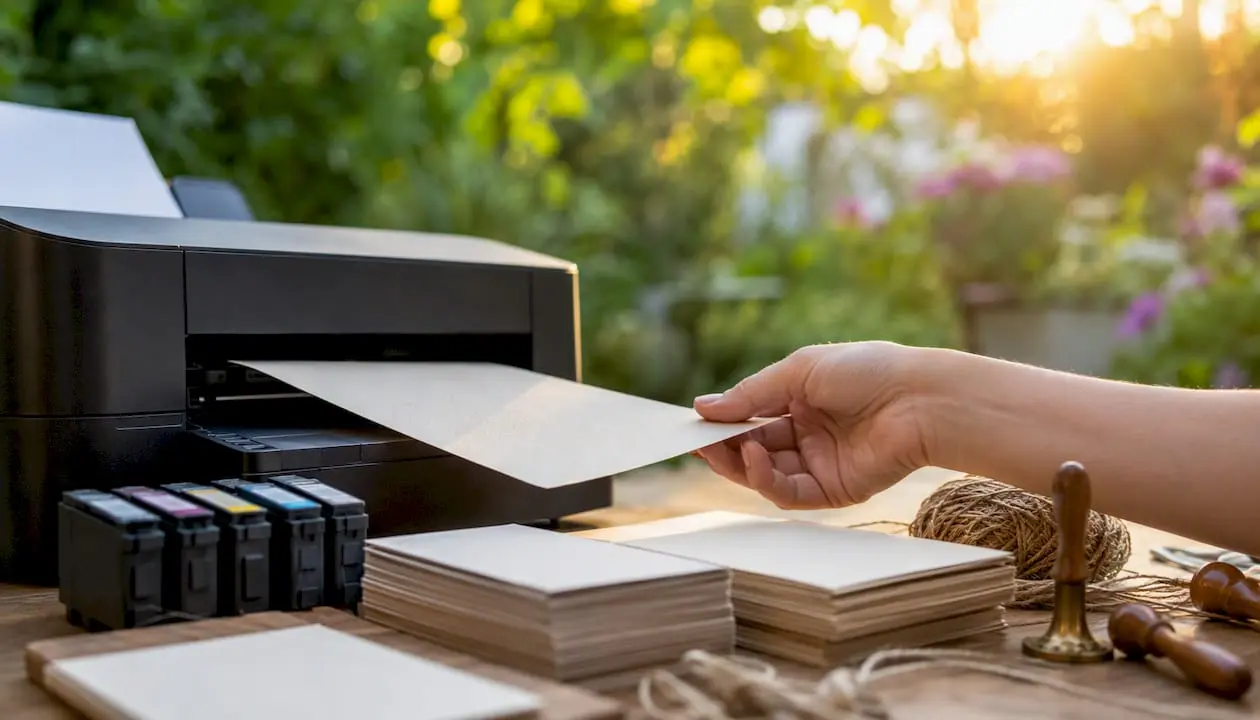
Inkjet printers work well with uncoated recycled boards. Pigment inks outperform dye-based inks for lightfastness and produce lower VOCs. Check that your cartridge brand offers a pigment option — many entry-level inkjets ship with dye inks by default.
Laser and toner printers handle heavier boards reliably and are often faster for multi-card batches. Confirm your model’s maximum GSM before feeding 300gsm stock; forcing thick card through a narrow feed path is the most common cause of jams and wasted sheets.
To cut waste further: select the correct paper profile in your printer driver, reduce ink density on solid colour fills (recycled boards absorb ink differently from coated stock), and run a low-ink draft proof before committing to a full print run. Canon’s home-printing guidance recommends pre-creased media and dedicated templates to reduce folding errors and speed up small-batch production.
| Method | Waste profile | Best for | Limitation |
|---|---|---|---|
| Home inkjet | Very low set-up waste | Short runs, personalised cards | Slower; check GSM limit |
| Home laser/toner | Low set-up waste | Faster batches, heavier boards | Higher upfront cost |
| Commercial litho | High make-ready waste | Runs of 500+ | Not relevant for home crafters |
Pro Tip: Print misprints on the blank reverse for practice cuts and scoring tests. You get free proofing material and nothing goes straight to recycling.
Which inks, finishes and envelopes keep cards recyclable?
For home printers, pigment inkjet inks and colour laser toner are the practical choices. Both have better lightfastness than dye inks and lower solvent content. Every component matters for truly sustainable printed items: paper, ink, and finish all need to work together.
Finishes to avoid:
- Plastic laminate (gloss or matt): prevents recycling and composting
- Soft-touch coatings: plastic-based, same problem
- Most UV varnishes: often petroleum-derived and non-recyclable
Stick to uncoated finishes. If you want a tactile effect, choose a naturally textured stock rather than adding a coating on top.
Advise buyers to remove any adhesive strips before recycling.
Pro Tip: When selling cards, include a small printed note stating the paper type, ink type, and disposal instructions. Buyers appreciate the transparency, and it reduces the chance of recyclable cards ending up in general waste.
How to set up files and avoid wasted prints
Start with the right template: CMYK colour profile, 3mm bleed on all sides, crop marks included, and fonts either embedded or converted to outlines. Using pre-creased templates and dedicated layout apps removes the most common source of wasted sheets — misaligned folds.
For folded cards, place the spine on the correct axis, mirror the back cover if needed, and keep critical text and images at least 5mm inside the trim line. Soft-proof in CMYK before printing; adjust saturation rather than brightness to avoid heavy ink deposits on recycled boards, which absorb ink more readily than coated stock.
Follow this checklist every time:
- Confirm finished size and fold direction match your template
- Set colour profile to CMYK (not RGB)
- Add 3mm bleed; check safe zone is 5mm inside trim
- Export at 300dpi minimum; embed all fonts or convert to outlines
- Run a low-ink draft proof on plain paper to check layout
- Print one full-quality proof on your chosen eco stock
- Check colours, fold alignment and text before printing the full batch
Fotospeed’s home-printing tips recommend test sheets and step-by-step layout checks for portrait, landscape and square formats. Their advice on pre-scored sheets is particularly useful for avoiding the cracked-fold problem common with heavier recycled boards.
Pro Tip: Save a dedicated printer profile for each stock you use regularly. Recalibrating from scratch every session wastes ink and paper; a saved profile gets you to a good result on the first sheet.
Where to buy eco paper and printable templates in the UK
For certified recycled paper and board, these UK suppliers are worth bookmarking:
- Antalis UK — stocks Image Bright White Recycled, which carries both FSC® and EU Ecolabel certification and works with inkjet and laser printers
- Recycled Papers — source for Teknocard 1 Recycled 100%, an FSC® Mix certified SBS board suited to heavier folded cards
- Specialist eco suppliers — for seed paper and bagasse stocks; always request a sample before ordering a full pack to confirm home printer compatibility
For printable templates and card-making downloads, Craftsuprint is the recommended starting point. The marketplace carries hundreds of ready-to-print designs sized for A4 and A3 home printing, including folded card kits with pre-marked crease guides. You can browse card-making templates and test designs on sample stock before committing to a larger print run.
Practical buying tips: order A4 or A3 cut sheets rather than rolls, request small sample packs before buying a full ream, and check that product pages state FSC®, EU Ecolabel, or Carbon Balanced claims explicitly. If a supplier cannot point you to a certification, treat the eco claim with scepticism.
Pro Tip: Buy envelopes from the same supplier as your card stock where possible. It simplifies certification checking and means you can confirm the full pack is recyclable without vetting two separate supply chains.
Pre-print checklist: run through this before every batch
- Stock confirmed: correct GSM, uncoated finish, acclimatised 24–48 hours
- Printer feed path checked: maximum GSM not exceeded
- ICC/paper profile selected in printer driver
- Bleed and crop marks confirmed in file
- Low-ink draft proof run and checked for layout
- Full-quality proof on eco stock approved before batch print
- Envelopes and packaging materials ready (100% recycled, plastic-free)
- Printer set to low-power standby between short batches to reduce energy draw
Pro Tip: Print in short batches of 10–20 sheets rather than one long run. Printers use the most energy during warm-up; keeping the machine in standby between small batches uses less power overall than leaving it running continuously.
Why this approach works better than the alternatives
The conventional advice for “eco printing” often points crafters towards commercial print services with carbon-offset schemes. That is not wrong, but it misses something: for short runs of personalised cards, home digital printing on certified stock is already the lower-waste option before any offset is applied. Digital printing removes plate set-up waste entirely, and printing on demand means you never overproduce.
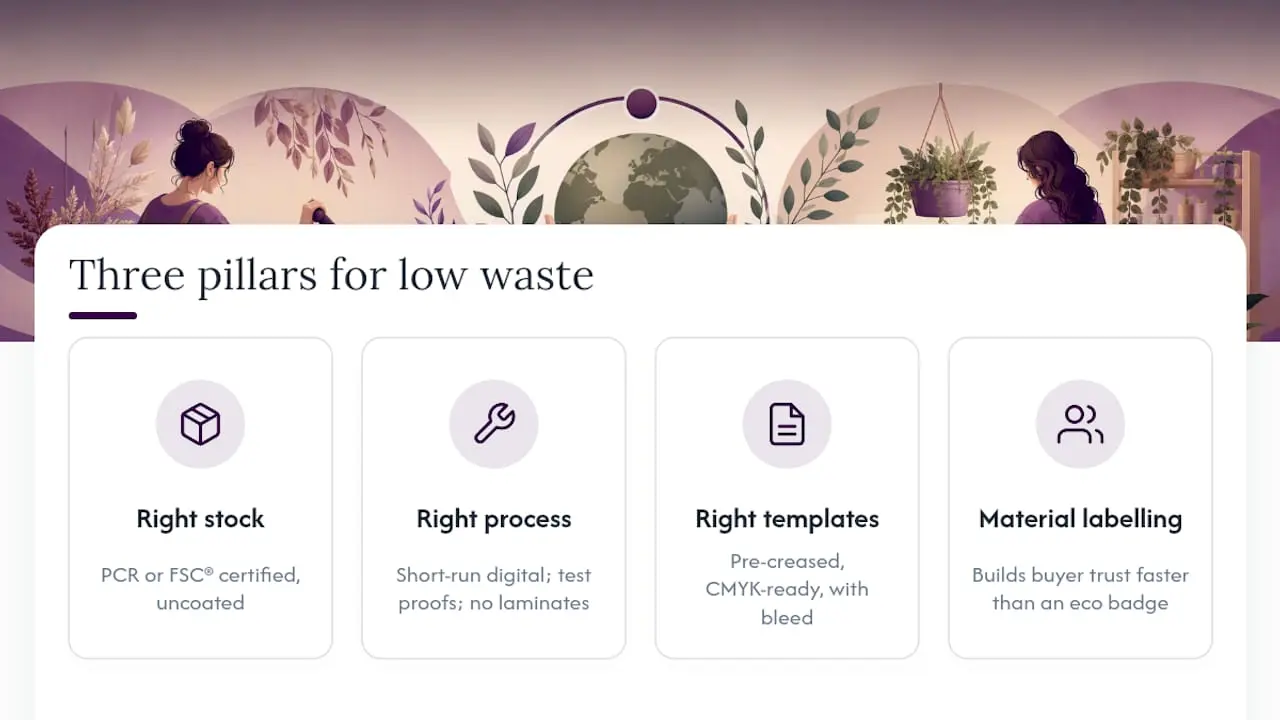
The real gains come from combining three things: the right stock (PCR or FSC® certified, uncoated), the right process (short-run digital, test proofs, no laminates), and the right templates (pre-creased, CMYK-ready, with bleed). Get all three right and the environmental case for home crafting is genuinely strong, not just a marketing claim.
For small sellers, clear material labelling on listings and pack inserts builds buyer trust faster than any eco badge. Buyers who know exactly what they are holding and how to dispose of it are more likely to return.
Craftsuprint: templates and supplies for sustainable home card making
Craftsuprint’s marketplace gives UK crafters direct access to downloadable card-making templates sized and formatted for home inkjet and laser printers. Designs come with fold guides and crop marks built in, so you spend less time on file setup and fewer sheets on test prints.
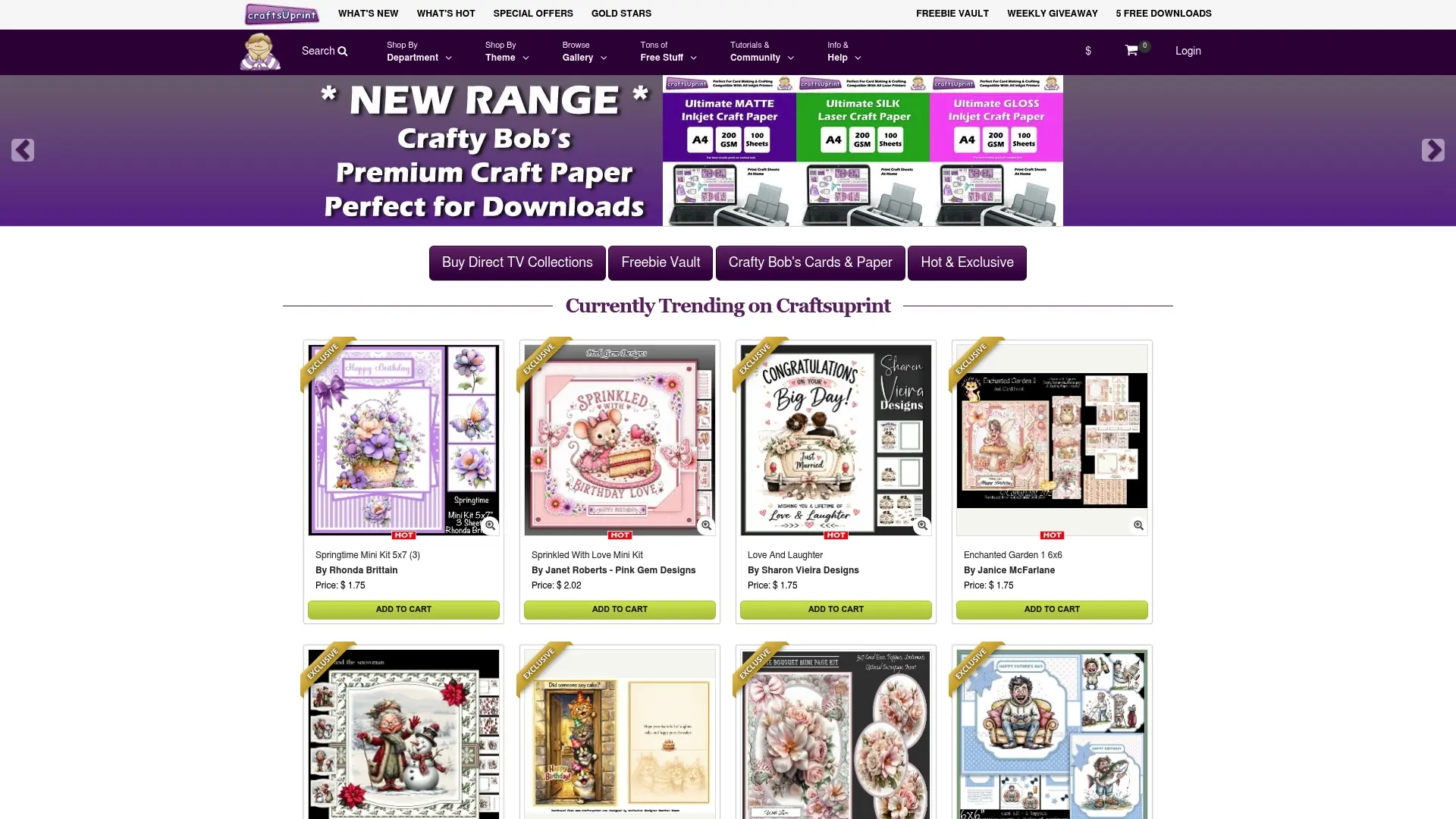
The craft supplies section lists eco-friendly paper and card materials alongside printable kits, letting you source templates and compatible stock in one place, with plenty of ideas for eco-friendly art projects at home. Weekly freebies and the Gold Star programme give small sellers a low-cost way to test new designs before committing to a print run. Grab a free Create & Craft download to see the template range, then order a paper sample pack alongside it to proof your chosen stock before printing a full batch.
Sources
- What is Eco-Friendly Printing? Your Guide to Print
- Eco-Friendly Boards for Greeting Card Printing
- Print your own greeting cards - Canon UK
- Teknocard 1 recycled 100% – Recycled Papers
- 200gsm smooth white A4 craft card – Mankey Monkey
- Eco-Friendly Business Cards – Sustainable Print
FAQ
What GSM card stock works best for home inkjet printers?
Most home inkjet printers handle 200–300gsm reliably; always check your model’s maximum GSM specification before feeding heavier boards. For folded A5 cards, 250–300gsm uncoated recycled stock is the practical sweet spot.
Does recycled card stock print as sharply as standard card?
Yes.
Which finishes should I avoid to keep cards recyclable?
Avoid plastic laminates, soft-touch coatings, and most UV varnishes. These prevent recycling and composting; uncoated finishes keep the card fully recyclable.
Where can I find printable eco-friendly card templates in the UK?
Craftsuprint offers hundreds of downloadable card-making templates formatted for home printers, including designs with fold guides and crop marks that reduce file-setup errors and wasted test sheets.
Is seed paper compatible with home printers?
Seed paper compatibility varies by product and printer model. Always order a sample pack and run a test sheet before printing a full batch, as the embedded seeds can affect feed reliability on some machines.