
Three fees that decide a UK designer’s take home from craft marketplaces

Every UK craft marketplace stacks three charges on top of your sale price: a marketplace commission, a payment processor fee, and VAT. On a £3 download, expect a significant portion of the gross price to disappear before it reaches your bank account, depending on whether you’re on a commission plan or a subscription tier. Craftsuprint, like many UK platforms, itemises each deduction separately rather than folding them into one opaque figure, which is why designers need to understand each layer before setting a price.
TL;DR:
- Whether VAT is deducted before or after commission significantly impacts your net payout, especially at different price points and sales volumes.
- Subscription plans generally become more cost-effective than per-sale commission only when monthly sales exceed around 20 to 30 downloads.
- Payment processor fees from Stripe or PayPal are passed directly to sellers and can add a small, additional cost to each transaction.
- Accurate invoice reconciliation requires verifying gross sales, VAT timing, processor fees, and micro-charges separately to identify discrepancies.
- Understanding the sequencing of fee calculations and checking platform policies on VAT application can prevent hidden margin erosion.
Table of Contents
- What are the different types of craft marketplace fees?
- When you get paid and how to check your invoice adds up
- Worked examples: what three price points actually net you
- How do you choose the right fee structure before listing?
- Why fee transparency matters more than the headline rate
- List your first pattern without the fee surprises
- FAQ
What are the different types of craft marketplace fees?
Most confusion about craft marketplace fees UK sellers face comes down to mixing up four separate charges that get deducted at different points and calculated in different ways. Once you can name each one on sight, reading a payout statement stops being guesswork.
Marketplace commission is the cut the platform takes for hosting your listing and processing the sale. Some sites charge a flat percentage on every transaction. Others use sliding bands, where the rate drops once you clear a monthly sales threshold. Folksy, for example, charges a small listing fee alongside a commission on the sale price, illustrating how both a listing charge and commission can apply to the same product.
Listing and subscription fees work differently again. A listing fee is charged whether or not the item sells, so a slow-moving pattern can cost you money sitting in the shop. Subscription tiers flip that logic: you pay a fixed monthly amount, often in exchange for zero or reduced commission. Crafter’s Market UK runs exactly this model, with a free basic tier that carries commission and paid tiers that strip commission out but add a subscription cost plus Stripe processing charges.
Payment processor fees sit on top of both of the above. In the UK, Stripe typically charges a small percentage plus a fixed fee per transaction for domestic cards, while PayPal’s standard commercial rate runs higher with a percentage plus a fixed fee. These aren’t marketplace charges. They’re the cost of moving money electronically, and most platforms pass them straight through to the seller rather than absorbing them.
Micro-charges are the least visible line. Card-scheme surcharges, currency conversion fees, or small regulatory pass-throughs sometimes show up as pennies per transaction. They rarely move the needle on a single sale but add up across hundreds of downloads a month.
The order these charges apply in matters more than most sellers realise:
- Some platforms deduct VAT from the gross price before calculating commission, which lowers the commission base.
- Others calculate commission on the full VAT-inclusive price, then remove VAT separately, which increases the total deduction.
- LoveCrafts documents exactly this kind of sequencing on its designer payment pages, and the order can shift your net payout by several percentage points depending on your price point.
Check the settings before you list. The difference between VAT-first and commission-first calculation isn’t cosmetic. It’s the difference between a viable price and one that quietly erodes your margin every month.
When you get paid and how to check your invoice adds up
Payout timing varies more than sellers expect, and it’s worth knowing the cadence before you plan around the income. Most UK craft platforms pay either monthly, on a fixed date, or on a rolling basis once your balance clears a minimum threshold. A typical timeline looks like this: a customer buys your download on the 3rd, the platform batches that sale into its monthly reconciliation, and you see the funds land around the end of the following month once processor fees have cleared and any refund window has passed.
Reading the invoice itself is where most disputes start. Follow this sequence each time a payout lands:
- Check the gross sale figure first. It should match the listed price times the number of units sold that period.
- Confirm whether VAT was deducted before or after commission. This should match the platform’s stated policy, and it should be consistent from one invoice to the next.
- Locate the payment processor fee line. If it’s missing entirely, ask the platform where it’s being absorbed. It’s rarely absorbed for free.
- Check for micro-fees or currency conversion charges, particularly if any sales came from overseas buyers.
- Total the deductions and confirm they match your net payout to the penny, not just roughly.
If a figure doesn’t reconcile, contact support with the specific transaction ID rather than the whole invoice. Platforms resolve line-item queries far faster than general “my payout looks wrong” tickets, and you’ll get a clearer answer about which deduction caused the shortfall.
Worked examples: what three price points actually net you
Numbers make this concrete faster than percentages alone.
- For a low-price download, VAT and commission deductions, plus processor fees, can significantly reduce net payout.
- Mid-range priced downloads see a similarly proportional deduction across VAT, commission, and processor fees.
- Higher priced downloads retain more net payout after these charges, though processor fees remain a small fixed cost.
With a subscription plan that removes commission, the deductions are limited to VAT and processor fees, resulting in a higher net payout. Whether that’s worthwhile depends entirely on your monthly volume, since the subscription cost has to be covered before it pays off.
Build this into a simple spreadsheet with columns for list price, VAT amount, gross excluding VAT, marketplace fee, processor fee, and net payout. Once the formulas are in, you can test a price change in seconds and see exactly how it lands.
Pro Tip: Before you commit to a price, run it through your spreadsheet at both your expected monthly sales volume and half that volume. If the subscription plan only wins at the higher figure, you’re betting on sales you haven’t made yet.
How do you choose the right fee structure before listing?
The right setup depends on numbers you should know before you list a single pattern, not on which platform has the most attractive homepage. Work through these criteria in order.
- Expected monthly sales volume. Low volume almost always favours per-sale commission, since a subscription fee becomes dead weight when you’re only selling a handful of downloads a month.
- Average item price. Higher-priced kits and bundles absorb a fixed subscription cost far more comfortably than 99p mini-downloads.
- VAT registration status. If you’re VAT-registered, you’ll need to check whether the marketplace expects you to handle VAT reporting yourself or whether it’s collected under its own scheme.
- Payout cadence. A monthly-only payout schedule matters if you rely on that income for regular expenses.
- Promotional support and analytics. Some platforms give sellers visibility into what drives conversions; others give you a bare sales total and little else.
Before listing, ask the marketplace directly: how is VAT applied, and can you see it itemised on every invoice? What does the chargeback and refund policy mean for your net payout if a buyer disputes a sale? Does the platform support multiple currencies, and if so, what’s the conversion fee? Get these answers in writing where you can, because verbal assurances at sign-up rarely match the fine print later.
As a rule of thumb, commission-only plans are usually best for sellers with lower monthly sales volumes, while subscription tiers often become more cost-effective as sales volume increases.
Why fee transparency matters more than the headline rate
Most sellers fixate on the commission percentage and ignore the sequencing question, which is the actual variable that decides whether a fee structure is fair. The headline number is marketing. The calculation order is the real story, and it’s the one detail platforms are least likely to volunteer upfront.
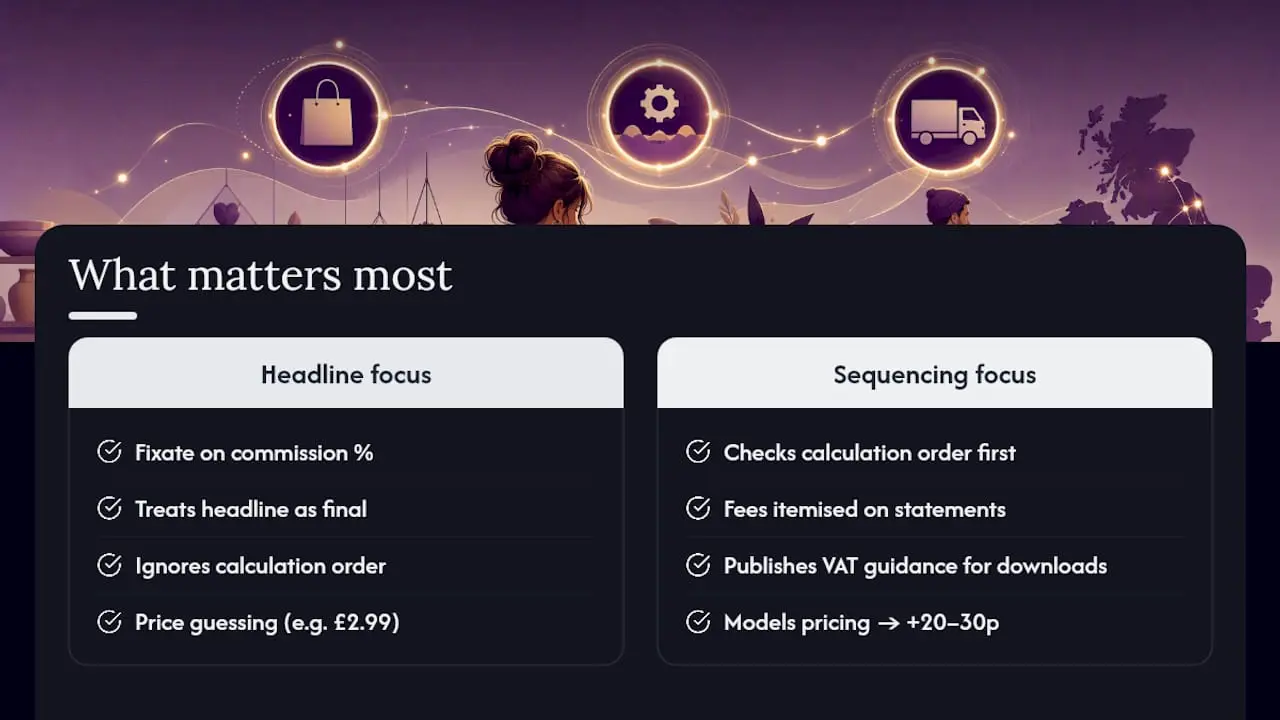
There’s also a habit worth breaking: pricing a download at a round number like £2.99 without ever checking what actually lands in your account. Designers who model their pricing properly, even in a rough spreadsheet, consistently price 20 to 30p higher on comparable items than those who guess, simply because the maths shows them where the margin actually sits.
Craftsuprint’s own approach reflects this thinking. The platform itemises fees on seller statements rather than bundling them into a single deduction, and it publishes direct VAT guidance for digital downloads so designers aren’t left guessing how tax interacts with commission. Community features like weekly freebies and the Gold Star programme sit alongside that transparency, giving designers a way to build visibility without extra fees stacked on top. For anyone comparing marketplace options more broadly, the platform’s own analysis of alternative marketplaces is worth reading precisely because it does not dodge the fee-structure differences that matter most.
— Rob
List your first pattern without the fee surprises
If you’ve read this far, you already know the real risk isn’t the commission rate. It’s discovering after the fact how VAT and processor fees interact with it. Craftsuprint is built around printable craft downloads specifically, so the fee structure and VAT guidance are written for exactly the kind of card-making kits and paper patterns you’re pricing, not retrofitted from a general handmade-goods marketplace.
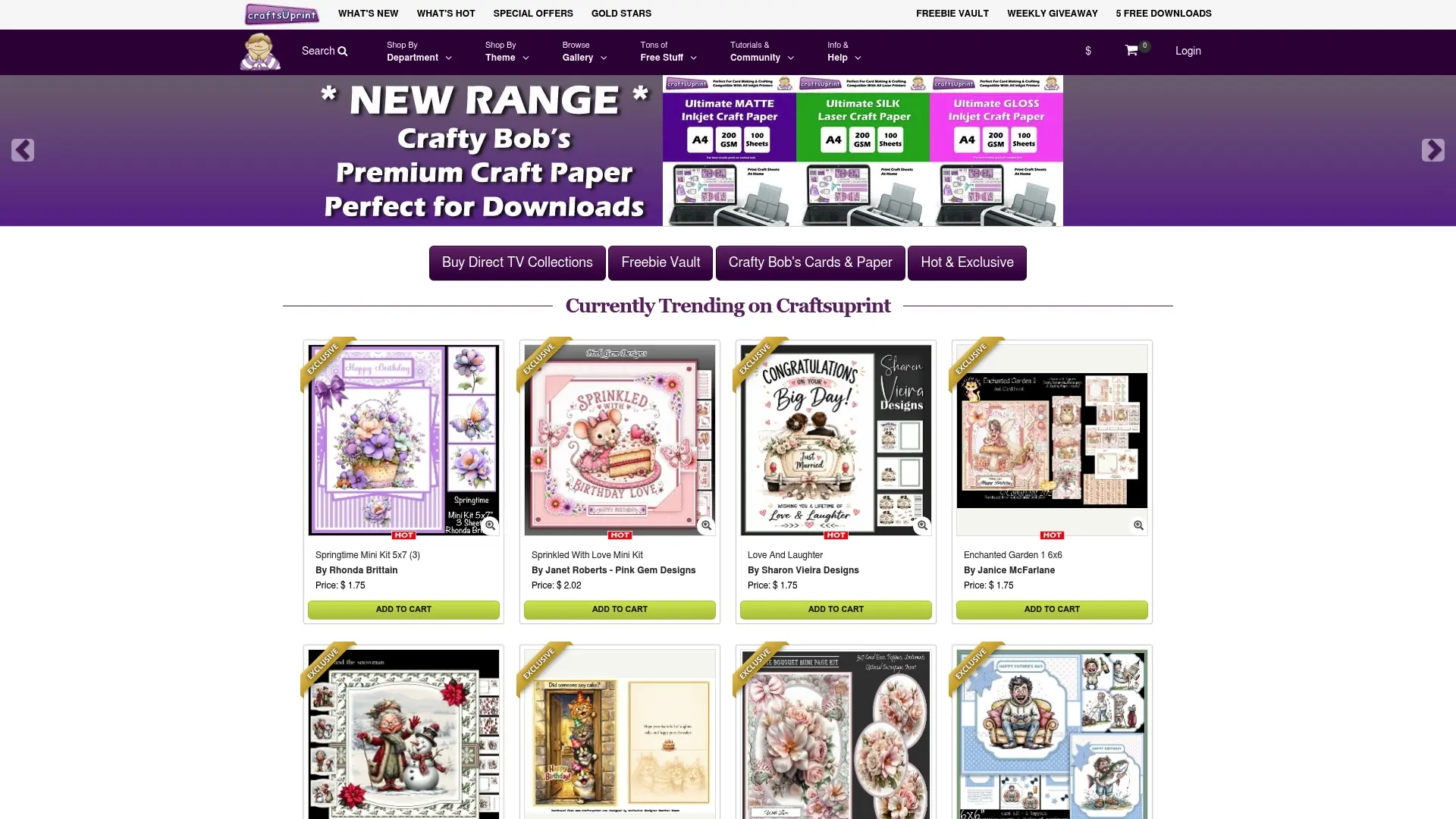
Start by reading the VAT guidance for digital downloads so you know exactly how tax is calculated before your first sale lands. Then browse the designer resources hub for practical listing and pricing guides, and list a test pattern to see how the fee breakdown appears on your own dashboard before committing your full back catalogue.
FAQ
What percentage do UK craft marketplaces typically take?
Subscription tiers often reduce or remove commission entirely in exchange for a fixed monthly cost.
Is VAT charged on top of marketplace commission or before it?
It depends on the platform. Some deduct VAT from the sale price first and calculate commission on the remainder; others calculate commission on the VAT-inclusive price. Check your marketplace’s stated policy, since it changes your net payout.
Do payment processors like Stripe and PayPal charge extra on top of marketplace fees?
Yes.
Does Craftsuprint charge VAT on digital downloads?
Craftsuprint follows UK VAT rules for digital products and publishes dedicated VAT guidance explaining how tax applies to craft downloads sold through the platform.
Is a subscription plan cheaper than per-sale commission?
Only above a certain sales volume. Below roughly 20 to 30 sales a month, per-sale commission usually costs less overall; above that, a subscription with reduced or zero commission typically works out cheaper.