
How 5%–50% Commission Rates Eat Your Craft Sale and What You Keep
Most craft marketplaces charge a commission in a range starting around single digits for straightforward online referral sales, rising to a moderate percentage on platforms that bundle in marketing or curation, and reaching up to half the sale price on some physical consignment or retail-split arrangements. Fees rarely arrive alone, so a marketplace’s headline percentage almost never matches your actual take-home. Before you commit to any platform, run the sale price through a simple calculation that stacks every charge, then judge the offer on what lands in your account, not the number in the sign-up email.
TL;DR:
- Most craft marketplaces charge a combined fee that can reach up to half the sale price, including commissions, processing fees, and VAT, so sellers should calculate net earnings carefully.
- Higher platform fees often include benefits like increased visibility, marketing support, buyer protection, and physical retail presence, justifying the added cost for many sellers.
- Flat processing fees significantly impact margins on low-priced items, with effective fee rates decreasing as sale prices increase, making it crucial to consider order size.
- Negotiating payment cadence, clarifying return policies, and avoiding long-term exclusivity clauses can improve sellers’ cash flow and profitability with marketplaces.
- For digital craft sales, platforms like Craftsuprint minimize costs by focusing on downloads rather than physical items, but sellers should still understand commission, processing, and VAT implications.
Table of Contents
- What craft marketplace commission rates actually look like
- The charges that get stacked on a craft sale
- How to calculate your effective take-home from a sale
- Choosing and negotiating with a marketplace or consignment venue
- Pricing strategy for makers: protect your margin
- How Craftsuprint approaches commission and seller take-home
- Author’s perspective: what actually moves the needle
- Selling digital crafts without the commission squeeze
- Sources
- FAQ
What craft marketplace commission rates actually look like
The spread is wide because “commission” means different things depending on the venue. A basic online marketplace charging a referral fee on digital or handmade items typically sits at the low end, often 5% to 15%. Curated platforms that actively promote listings, run email campaigns, or vet sellers before approving them tend to land in the 15% to 35% band. Physical consignment shops and some retail-split arrangements can take up to half the sale price, because they’re covering shop rent, staff wages, and in-person display space.
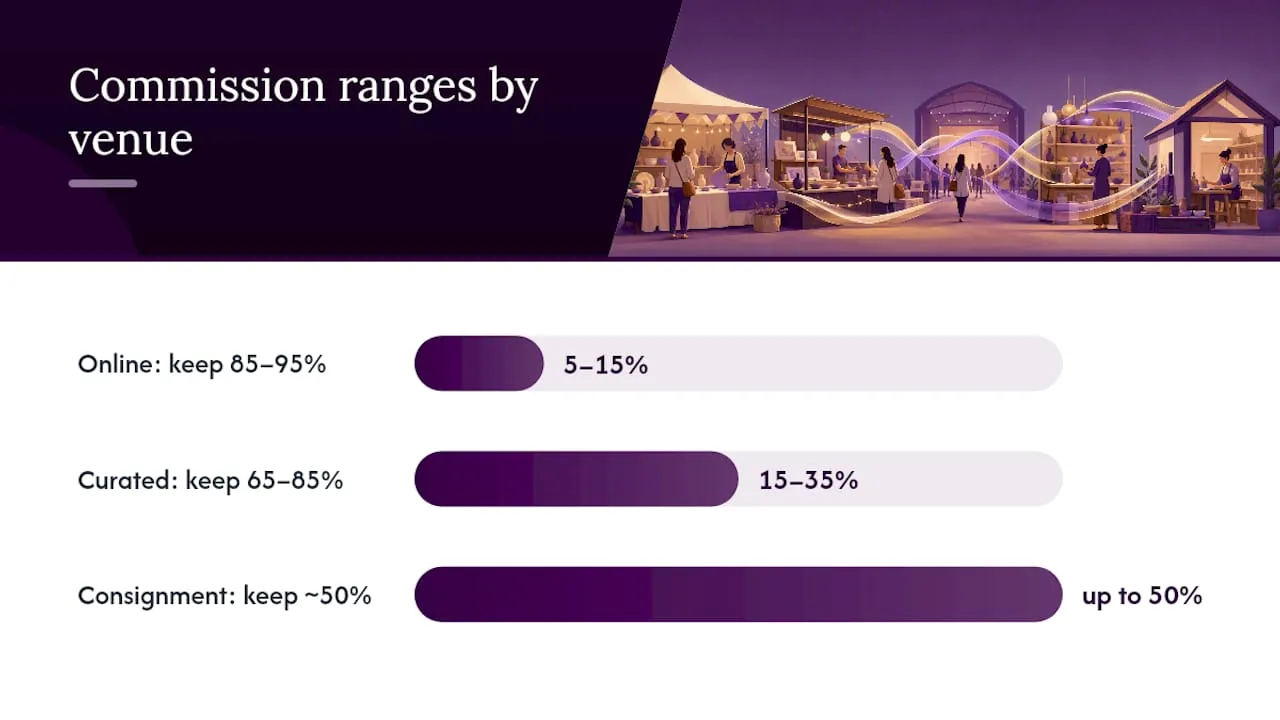
These are observed ranges pulled from how different platforms structure their charges, not fixed industry rates you should expect everywhere. A gallery gift shop and a print-on-demand marketplace are solving completely different problems, so comparing their percentages directly is misleading.
Higher fees usually buy something specific:
- Curated placement or featured listing slots that lift visibility above the general search results.
- Marketing spend the seller doesn’t have to fund directly, such as paid social campaigns or newsletter inclusion.
- Payment and fraud protection, including chargeback handling and buyer dispute resolution.
- Physical retail presence: shelf space, staffing, and till processing that an online-only seller would otherwise pay for separately.
Some niche platforms advertise unusually low commissions by calculating the percentage after processing fees are already deducted, which makes a “5.5% commission” look far cheaper than it behaves once you add the processor’s cut back in. Always check what the percentage is calculated against before comparing two platforms side by side.
The charges that get stacked on a craft sale
Selling crafts online rarely involves paying just one fee. Online marketplaces typically stack three charges on a single sale: a marketplace commission, a payment processing fee, and VAT where it applies. Understanding each line separately is the only way to spot which ones are negotiable.
- Listing fees: a small per-item charge to publish a product, common on marketplaces that don’t charge commission, or charged alongside a lower commission rate.
- Marketplace commission or referral fee: the percentage cut on each sale, sometimes flat, sometimes tiered by category or sale value, occasionally with a minimum fee per order regardless of price.
- Payment processing: usually a percentage plus a small fixed amount per transaction, similar to standard card processing structures.
- Subscription or storefront fees: a recurring monthly charge for maintaining a shop, separate from any per-sale commission.
- Onboarding or application fees: a one-off charge some curated marketplaces apply before you’re approved to sell.
- Consignment splits: physical venues often take a flat percentage of the retail price rather than charging separate listing or processing fees.
Returns complicate the maths further. Some marketplaces refund the commission when an item is returned; others keep it, leaving you covering the processing fee on a sale that never really happened. VAT-registered sellers also need to account for VAT on the sale price before commission is deducted, not after, since the two calculations produce very different net figures.
How to calculate your effective take-home from a sale
The formula is straightforward once you have every fee line in front of you:
Net take-home = Sale price − (Marketplace commission + Payment processing fee + VAT owed + Any flat fees)
Marketplace fee formulas vary by platform type, some use a flat percentage referral fee, others combine a smaller commission with listing and processing charges that add up to a similar effective rate. Running the numbers on a few typical sale prices shows how the effective fee percentage shifts depending on order size, because flat fees weigh more heavily on cheaper items.
| Sale price | Commission (15%) | Processing (percentage plus small fixed fee) | Total fees | Effective fee rate | Net take-home |
|---|---|---|---|---|---|
| £10 | £1.50 | £0.59 | £2.09 | around 21% | £7.91 |
| £30 | £4.50 | £1.17 | £5.67 | around 19% | £24.33 |
| £60 | £9.00 | £2.04 | £11.04 | around 18% | £48.96 |
Pro Tip: Notice the effective fee rate falls as the sale price rises. If your average order value is low, a flat per-transaction processing fee will quietly eat a bigger share of your margin than the commission itself.
Choosing and negotiating with a marketplace or consignment venue
Before signing anything, weigh a platform against your own priorities rather than its marketing copy.
- Check audience fit: does the marketplace’s existing buyer base actually shop for what you make, or are you paying for exposure to the wrong crowd?
- Read the payment cadence: some platforms pay out weekly, others monthly, which affects your cash flow more than the commission rate does.
- Clarify returns and chargeback liability: find out in writing who absorbs a refunded commission and who covers a disputed payment.
- Check exclusivity clauses: some consignment agreements forbid selling the same items elsewhere while the contract runs.
- Confirm termination notice: a 30-day notice period is manageable; a 12-month lock-in is not.
Negotiation is more possible than most new sellers assume. Introductory lower-commission trials or limited-time co-marketing arrangements let you test a platform without permanently giving away margin. Watch for red flags: opaque sales reporting, mandatory long-term exclusivity, or monthly fees buried in the small print rather than stated upfront.
Pricing strategy for makers: protect your margin
Set your base price to recover materials, your labour at a realistic hourly rate, overhead, and a target margin, then treat the marketplace commission as a cost you add on top rather than one you absorb by underpricing yourself.
- Build tiered pricing for variations (size, personalisation, materials) rather than one flat price that punishes complex orders.
- Pass on shipping costs separately instead of folding them into the item price, which keeps your margin visible order by order.
- Add an explicit customisation or rush-order surcharge as its own line item. It makes refunds and negotiations far cleaner than hiding the cost inside the unit price.
- Keep a direct sales channel running alongside any marketplace presence, even a simple one, so repeat buyers can order without a third party taking a cut every time.
A multi-channel strategy that steers loyal customers towards your own site over time reduces your lifetime commission exposure more than any single negotiation ever will. For a deeper look at how your own website compares with relying on third-party sellers, this comparison of website versus marketplace selling is worth reading before you commit fully to any one platform.
How Craftsuprint approaches commission and seller take-home
Craftsuprint runs as a marketplace for digital craft downloads: card making kits, paper patterns, and printable designs, where independent designers earn from each purchase rather than paying to list stock they might never sell. That structure suits makers whose product is a file, not a physical item needing storage, packaging, or postage.
- The Gold Star programme rewards active designers and gives sellers a way to build income through the platform’s community features.
- Practical guidance on how marketplace fees actually work for UK designers breaks down commission, processing, and VAT specifically for sellers working through Craftsuprint.
- A step-by-step guide to selling digital crafts walks new sellers through listing their first design.
- Designers exploring extra income streams can also look at affiliate programme opportunities built around the same marketplace.
Author’s perspective: what actually moves the needle
Three things matter more than the headline rate: know your effective fee before you list, negotiate payment cadence as hard as commission, and never rely on one channel. One maker I’ve seen described moved half her repeat buyers to a direct channel and lifted her per-sale take-home by roughly a fifth within months. Test any new marketplace with a small batch first, then scale once the real numbers check out.
— Rob
Selling digital crafts without the commission squeeze
Craftsuprint is worth a look if what you make lives on a screen before it ever reaches paper: card kits, patterns, printable designs. There’s no storage, no postage, no returns to argue about, and the marketplace’s commission structure is built around designers earning from downloads rather than fighting listing fees and shipping costs at every turn.
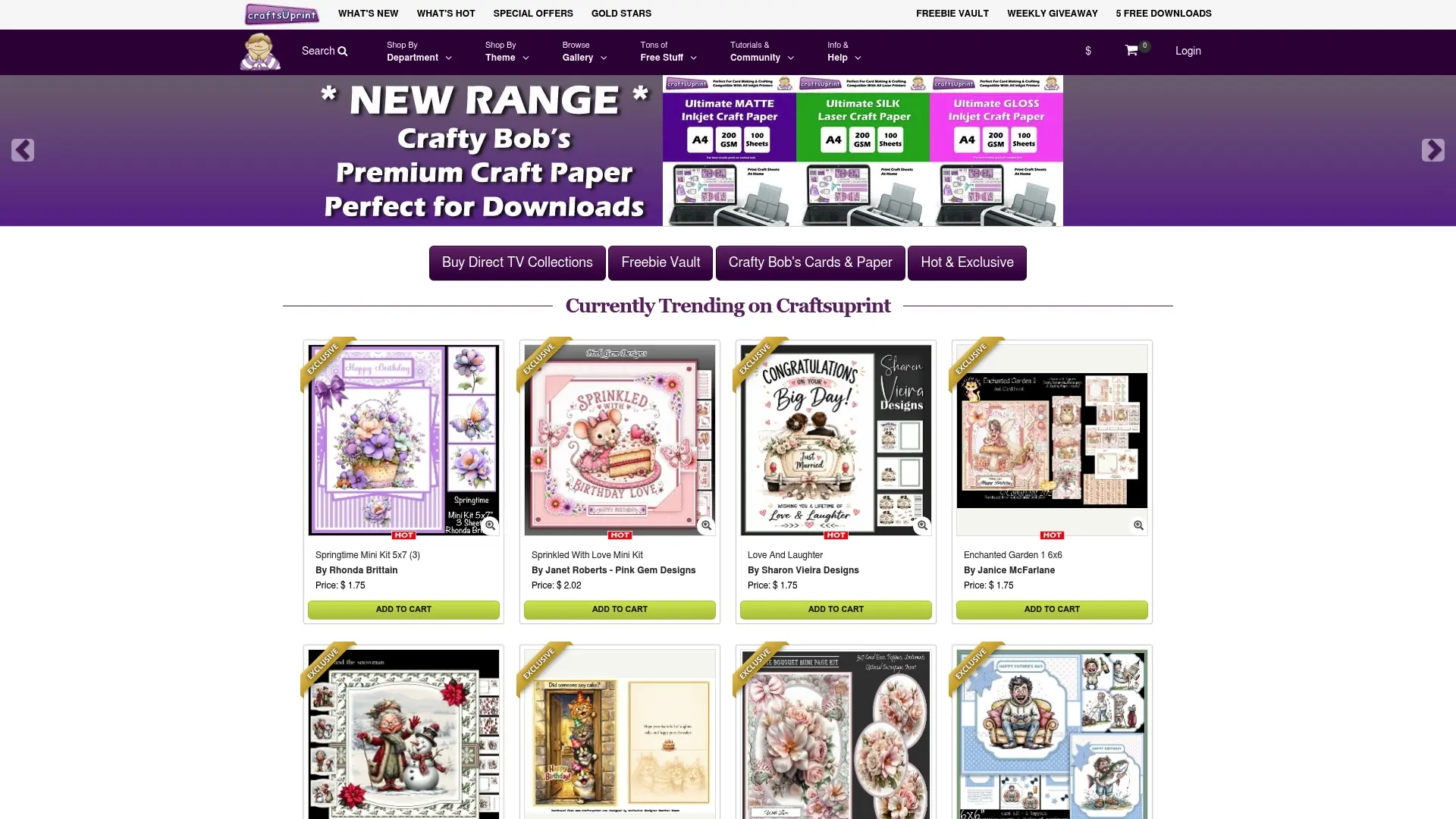
The Gold Star programme rewards designers whose work sells consistently, and Guides are available that walk you through pricing, listing, and getting paid without the guesswork that comes with a brand-new platform. If you’ve got a design sitting on your hard drive, the Create & Craft downloads page shows what a live storefront actually looks like before you commit to your own. Start there, browse a few sellers’ listings, then set up your first upload.
Sources
- The real cost of selling on Etsy (Gelato blog)
- Seller fees 2026: marketplace fee formulas by platform (SellerFeeCalc)
- Where to sell handmade crafts (Shopify blog)
- My Craft Market marketplace fees example (My Craft Market)
FAQ
How much should I price my handmade items?
Price to cover materials, your labour at a fair hourly rate, overhead, and your target margin first, then add the marketplace’s commission and processing fees on top rather than absorbing them into that base figure.
What is the hottest selling craft right now?
Demand shifts by season and platform, so it’s more useful to track what sells consistently within your own niche and price range than chase a trending category that may not suit your skills or materials.
What is Creative Market’s commission rate for sellers?
Specific platform rates change over time and aren’t detailed in this guide’s research, so check the current seller terms directly on the platform rather than relying on a figure that may be out of date.
Do you have to pay to sell at a craft fair?
Most physical craft fairs charge a stall or table fee upfront, separate from any commission, and some also take a small percentage of sales on top, so check both charges before booking a space.
How do craft marketplace fees typically stack up against consignment shops?
Online marketplaces usually charge a lower combined rate, often 5% to 15% plus processing, while physical consignment or retail-split arrangements can take up to half the sale price because they cover shop overheads and staffing.