
Craft design licensing explained for small sellers

Buying a design file feels like ownership. It rarely is. This is the misunderstanding at the heart of most licensing mistakes crafters make, and it is exactly why understanding how to explain craft design licensing matters before you sell a single item. Selling items featuring copyrighted designs without the proper permissions can lead to legal action, DMCA takedowns, and lost income, even if you are trading at a local market. This guide will walk you through the types of licences that exist, what the terms actually mean, and how to keep your craft business on solid legal ground.
Table of Contents
- Key takeaways
- Understanding craft design licensing from the ground up
- What to check when using third-party assets
- Creative Commons licences and what they mean for crafters
- Comparing licence scopes: a quick reference
- Managing licensing risk in your craft business
- My honest take on licensing after years in the craft world
- Explore licensed craft resources at Craftsuprint
- FAQ
Key takeaways
| Point | Details |
|---|---|
| Buying does not equal selling rights | Purchasing a digital design file grants personal use only unless a commercial licence is explicitly included. |
| Licence types change what you can do | Exclusive, non-exclusive, and sole licences grant very different levels of control over how you use a design. |
| Creative Commons has real restrictions | Not all CC licences allow commercial use or modifications; always check the specific elements before using an asset. |
| Documentation protects your business | Keeping receipts and licence files in a organised folder reduces your risk if a dispute arises. |
| Licence tiers affect your revenue | Offering personal and commercial tiers can increase a designer’s earnings by 30 to 50 per cent. |
Understanding craft design licensing from the ground up
At its most basic level, craft design licensing is a legal agreement between the creator of a design and someone who wants to use it. The creator retains ownership of the copyright. What the licence grants is permission to use the design under specific conditions. Those conditions are everything.
Licence agreements typically specify ownership retention, payment or royalty terms, termination rights, and the legal jurisdiction that governs the contract. For crafters, the clauses that matter most day-to-day are scope of use, territory, term, attribution, and sublicensing. Scope tells you what you can do with the design. Territory tells you where. Term tells you for how long.
The three most common licence structures you will encounter are:
- Personal use licence. You can use the design to make items for yourself or as gifts. You cannot sell products made from it.
- Commercial use licence. You can sell products made using the design, subject to any restrictions in the agreement such as a cap on the number of units.
- Extended commercial licence. This typically removes or raises product limits, allows wider distribution, and sometimes permits use across multiple platforms or sales channels.
There is also the distinction between exclusive, non-exclusive, and sole licences. A non-exclusive licence lets the designer sell the same rights to many buyers. An exclusive licence means only you hold those rights. A sole licence sits in the middle: only you and the original creator can use it. Key licence clauses including exclusivity help define these usage boundaries and prevent disputes before they arise.
Pro Tip: If a licence agreement does not explicitly mention commercial use, assume it is personal use only. When in doubt, contact the designer directly before you start selling.
What to check when using third-party assets
Fonts, clip art, and templates are where most crafters unknowingly cross a legal line. The practical reality of licensing for crafters is that every asset you use in a design carries its own separate licence, and those licences do not automatically transfer commercial rights just because you paid for the file.
Here is a step-by-step process to follow before you use any third-party asset in a commercial product:
- Locate the licence document. Most reputable sellers include a PDF or link to their terms in the download folder. If there is nothing, check the seller’s website or listing description.
- Identify the use type. Look for the words “commercial use,” “commercial licence,” or “for sale.” Personal use licences will usually say so explicitly.
- Check for product or unit limits. Some standard commercial licences cap you at 500 physical units or restrict digital resale. If your business is growing, an extended licence may be necessary.
- Confirm sublicensing rights. If you sell a kit that includes a font or graphic, are buyers allowed to use it in their own products? Many licences prohibit passing rights to a third party.
- Save the licence file. Store a copy alongside your purchase receipt in a folder named by designer or asset. You will need this if your shop ever receives a copyright complaint.
- Review the licence periodically. Designers can update their terms. What was allowed two years ago may have changed, particularly on subscription-based asset platforms.
Fonts without commercial licences are among the biggest infringement risks in the craft industry. Google Fonts are a safe commercial use option, but many beautiful script fonts on popular download sites default to personal use unless you pay for an upgrade. The same is true for many illustration packs and watercolour clip art sets. A paid download is not the same as a commercial licence.
Pro Tip: Create a simple spreadsheet with columns for asset name, licence type, unit limit, platform restrictions, and date of purchase. Thirty minutes of admin now can save you hours of legal stress later.

Creative Commons licences and what they mean for crafters
Creative Commons licences are widely used across stock image sites, design repositories, and educational platforms. Understanding them is part of any thorough understanding of craft design licensing. The key thing to know is that all CC licences are irrevocable and precisely defined by their specific elements. Once a creator applies a CC licence to their work, it stays applied.
The four licence elements combine to create six main licence types:
- BY (Attribution): You must credit the original creator. This applies to all CC licences without exception.
- NC (Non-Commercial): You cannot use the work for commercial purposes. Any licence with NC is off-limits for selling craft products.
- ND (No Derivatives): You cannot alter, remix, or adapt the work. This rules out using the asset as part of a composite design.
- SA (ShareAlike): Any derivative work must carry the same licence as the original.
For commercial craft use, the only CC licences that work are CC BY and CC BY-SA, as these are the only ones that do not include the NC (Non-Commercial) restriction. CC BY-SA does require that any product you sell using the design also carries a CC BY-SA licence, which has implications for how you describe and sell your items.
Proper CC attribution requires you to include the asset’s title, the creator’s name, a link to the source, and the specific licence type. Simply writing “image from Flickr” does not meet the standard. Improper attribution is one of the most common CC violations, and it can still result in a takedown notice even if the underlying use was otherwise permitted.
Choosing which Creative Commons licence to apply to your own work is a deliberate policy decision. It directly shapes how others can reuse and commercialise what you create. Think carefully before publishing your designs under any CC licence, because you cannot revoke it later.
Comparing licence scopes: a quick reference
Choosing the right licence when buying or selling designs is much easier when you can see the differences side by side.
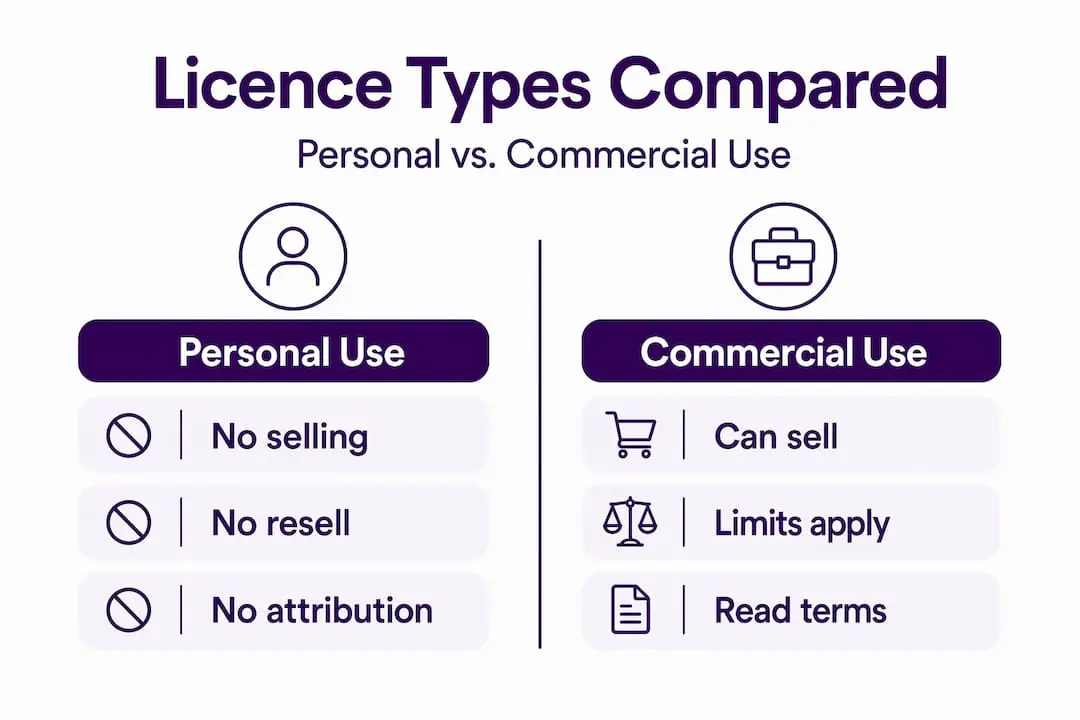
| Licence type | Can you sell products? | Unit or product limits? | Can buyers resell assets? | Attribution required? |
|---|---|---|---|---|
| Personal use | No | Not applicable | No | Varies |
| Standard commercial | Yes | Often (e.g. 500 units) | No | Sometimes |
| Extended commercial | Yes | Rarely or none | No | Sometimes |
| Exclusive commercial | Yes | No | Depends on terms | Sometimes |
| CC BY | Yes | No | Yes, with credit | Yes |
| CC BY-NC | No | Not applicable | No | Yes |
Commercial licence tiers for printables typically separate personal from commercial use clearly, with standard, extended, and unlimited tiers affecting scope. For a small business printing 50 birthday card kits a month, a standard commercial licence is usually sufficient. For a seller distributing digital downloads that buyers then print and sell, an extended or unlimited licence is almost certainly needed.
Platform restrictions also vary. Some licences permit selling on one platform only, such as Etsy, and require a separate licence for a second shop. If you sell across multiple channels, this is worth examining carefully in every licence you hold.
Managing licensing risk in your craft business
Keeping your business legally protected is not a one-time task. Craft design rights need to be actively managed, especially as your product range grows and you add new assets over time.
Practical steps to reduce your exposure include:
- Audit your existing designs. Go through every product you currently sell and identify each asset used. Check that you hold the appropriate commercial licence for each one.
- Use safe font sources. Stick to Google Fonts, Font Squirrel’s commercial-use filtered catalogue, or fonts purchased with verified commercial licences. Never assume a font is free to use commercially.
- Write clear listing descriptions. When selling your own designs, state explicitly what buyers are and are not permitted to do. Ambiguous listings cause disputes and refund requests.
- Keep a secure licence archive. Store PDFs, receipts, and confirmation emails in a cloud folder organised by asset. Back it up regularly.
- Revisit licences when you scale. A licence that covered 200 units may no longer be valid once your product sells 2,000. Check the terms before you scale production.
- Seek legal advice for grey areas. If a licence is genuinely unclear or you are creating derivative works from multiple sources, a short consultation with an intellectual property solicitor is worth the cost.
The importance of craft design to your bottom line goes beyond creativity. Solid licensing practice is what separates a sustainable business from one that gets a shop suspension or legal notice out of nowhere.
My honest take on licensing after years in the craft world
I have spoken with hundreds of independent designers over the years, and the pattern is almost always the same. They start with passion, build a following, grow their product range, and then one day receive a takedown notice because they used a font or graphic without the right licence. It is not malicious. It is simply a gap in knowledge that nobody told them to fill.
What I have found is that the crafters who treat licensing as a creative tool rather than a legal burden are the ones who grow most confidently. When you know exactly what rights you hold, you make better decisions about what to create, what to sell, and how to price it. Offering tiered licences for your own designs, for example, is not just legally sound. It is a genuine revenue strategy.
The uncomfortable truth is that most crafting communities talk about tools and techniques constantly, but almost never discuss craft intellectual property in plain terms. That silence is expensive. I have watched talented designers lose shops, income, and confidence because of something that a single afternoon of reading could have prevented.
My advice is this: build your licence archive from day one, even if it feels like unnecessary admin when you are just starting out. Future you will be grateful. And when you are unsure, ask. Designers and licence holders are usually far more approachable than people assume.
— Rob
Explore licensed craft resources at Craftsuprint
If you are ready to put your licensing knowledge into practice, Craftsuprint is built with exactly that in mind.
At Craftsuprint, every download comes with clearly stated licensing terms, so you know precisely what you are buying before you use it commercially. Whether you are looking for card making kits, paper craft templates, or tutorial resources to expand your range, the platform makes it straightforward to find designs that fit your selling needs. Independent designers on Craftsuprint also benefit from transparent terms that help protect their work while reaching a community of enthusiastic buyers. Browse the craft downloads and tutorials to find licensed resources that support your business from the start.
FAQ
What does craft design licensing actually mean?
Craft design licensing is a legal permission granted by a design’s copyright owner that defines how, where, and for what purpose another person can use that design. It does not transfer ownership of the copyright.
Does buying a digital design file give me the right to sell products?
No. Purchasing a digital file typically grants personal use rights only. You need a specific commercial use licence to legally sell products made from that design.
Can I use Creative Commons designs in my craft products for sale?
Only if the licence does not include the NC (Non-Commercial) element. CC BY and CC BY-SA licences permit commercial use, but you must provide proper attribution including the creator’s name and licence type.
What is the difference between a standard and extended commercial licence?
A standard commercial licence usually caps the number of products you can sell, often around 500 units, while an extended commercial licence removes or significantly raises those limits and may allow broader platform or distribution use.
How do I protect myself from licensing disputes as a designer?
Keep a secure archive of every licence you purchase, write clear terms into your own product listings, and audit your designs regularly to confirm that each asset still complies with its licence conditions.